What Is a Good SAT Score? 2026 Benchmarks by College Type
There is no single "good" SAT score. A 1200 puts you above three-quarters of all test-takers nationally, but it's below the 25th percentile at every Ivy League school. The honest answer is that a good score is one that lands inside or above the middle 50% of admitted students at the colleges you actually want to attend. This guide gives you the national percentile bands, the typical ranges by college selectivity tier, and a practical way to set your own target.
Higher-education data team
Sources: Sourced from College Board percentile reports and the U.S. Department of Education College Scorecard.
The national picture: what the percentiles say
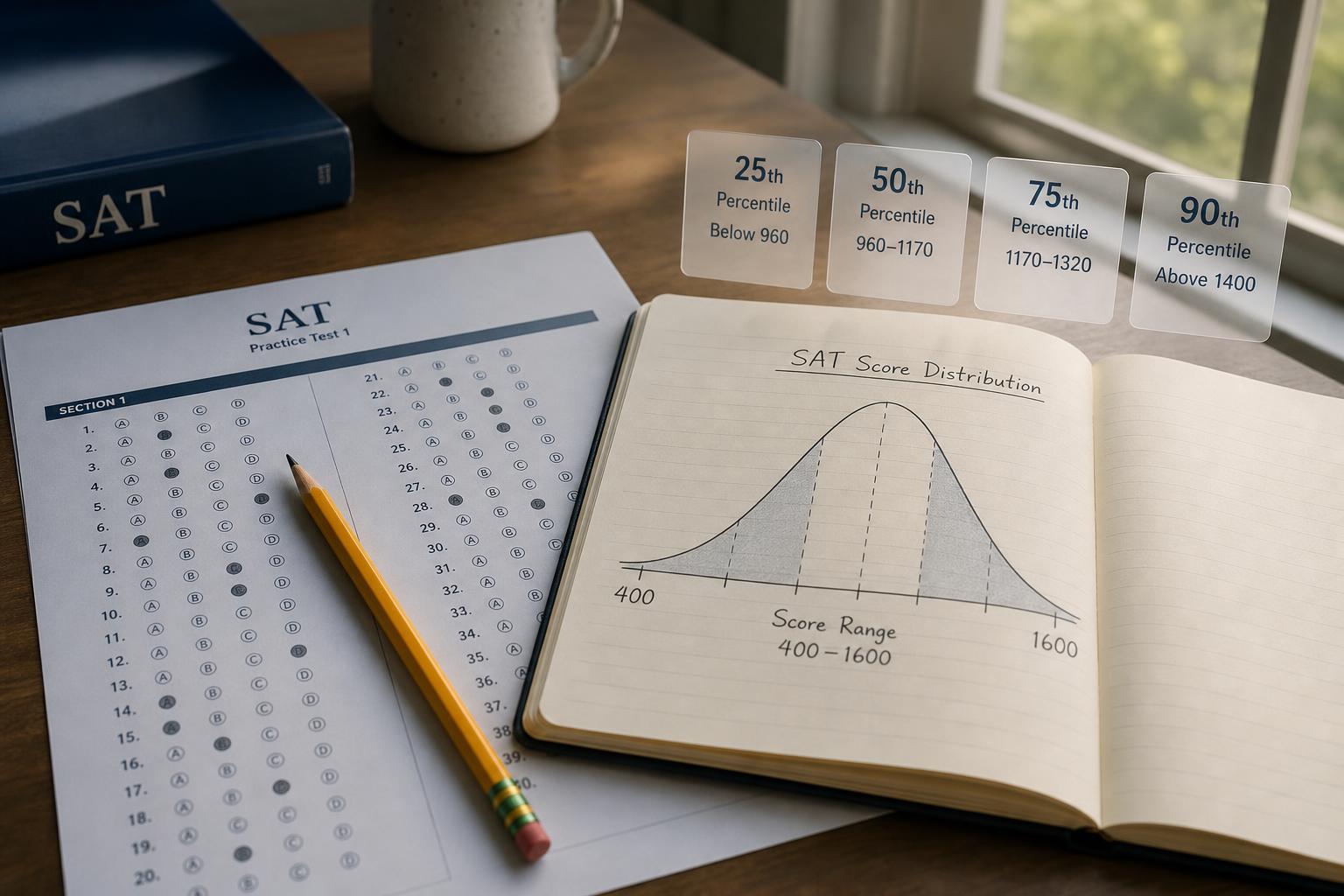
The SAT is scored from 400 to 1600, combining the Reading & Writing and Math sections (200–800 each). The College Board's nationally representative percentiles are the cleanest way to see where a score sits versus all U.S. 11th- and 12th-graders.
As a rough 2024–2025 benchmark: a 1050 is roughly the 50th percentile, a 1200 is around the 75th percentile, a 1350 is around the 90th, and a 1450+ puts you in the top 5%. Scores at 1500 and above are inside the top 2% of all test-takers.
These are useful anchors, but they aren't admissions targets. Selective colleges aren't drawing from the whole population of test-takers, they're drawing from a self-selected, higher-scoring slice.
What counts as "good" depends on where you apply
Admissions offices publish the 25th and 75th percentile SAT scores of their admitted or enrolled class. A score above the 75th makes you competitive on the SAT axis; below the 25th, you're working against the grade. Here are typical middle-50% ranges by college tier:
- Most-selective (Ivy League, MIT, Stanford, Caltech, top LACs): roughly 1490–1570
- Highly selective (UChicago, Duke, Northwestern, Vanderbilt, Rice, top publics like Michigan and UCLA): roughly 1440–1540
- Selective flagships and strong privates (UNC, UVA, Wisconsin, NYU, BU, USC): roughly 1340–1500
- Mid-selective public and private universities: roughly 1170–1380
- Open-access and broad-access institutions: SAT is often optional or used for placement only.
A 1350 is a strong score at a mid-selective state flagship and a below-average score at MIT. The number on the page is the same, the context isn't.
Test-optional changes the question, not the math
Roughly 80% of four-year colleges are test-optional or test-blind for the 2025–2026 cycle, according to FairTest. Test-optional doesn't mean tests don't help, it means submitting helps if your score is at or above the school's middle-50% range, and skipping is usually better if it isn't.
A simple decision rule: if your score is at or above the school's 50th percentile (the midpoint of the 25–75 range), send it. If it's below the 25th percentile, don't. In between is a judgment call that depends on the rest of your application.
How to set your own target score
1. Build a list of 6–10 schools you're seriously considering. Browse by state on the states directory or by program on the programs directory.
2. Look up each school's most recently published middle-50% SAT range (usually on the admissions page or in the Common Data Set, Section C9).
3. Take the median of the 75th-percentile scores across your list. That number, not a generic national average, is your target. Hitting it makes you competitive across the list.
4. Pair the score target with the school's net price and graduation rate, because admission is only half the question. A school you can get into but can't afford to finish isn't a good fit.
When to retake, and when to stop
Most students improve 30–70 points between a first and second sitting with focused prep, and gains tend to flatten after the third attempt. If your current score is more than 50 points below your target, a retake is usually worth it. If you're already above your target, additional retakes have diminishing returns, your time is better spent on essays, course rigor, and the application itself.
Selective colleges almost all superscore (taking your highest section scores across dates) or accept Score Choice, so a lower retake rarely hurts. Check each school's policy before deciding.
Further reading
On UniScorecard
- How to compare colleges
Pair a score target with cost and graduation outcomes.
- Browse schools by state
Find admissions and outcomes data for any U.S. college.
- Browse programs by field
See where your intended major is strongest.
- Compare schools side-by-side
Up to four schools on every metric.
- Our methodology
How we define and source every metric.
External sources
- College Board SAT Suite Program Results ↗
Official national percentile distributions.
- FairTest test-optional list ↗
Up-to-date list of test-optional and test-blind colleges.
- Common Data Set initiative ↗
Where colleges publish their admitted-class score ranges (Section C9).
Related guides
Test-Optional Colleges 2026: Who Requires the SAT Now
Which colleges are test-optional, test-blind, or SAT-required for the 2026-27 cycle (class of 2027), and how to decide whether to submit a score.
When Do College Decisions Come Out?
Early decisions arrive in December, regular decisions in March, and rolling decisions in weeks. See every timeline and plan your spring with confidence.
Rolling Admission Colleges: When to Apply
Find rolling admission colleges, check priority dates and scholarship rules, and build an October application plan without missing key steps. Start here.
Frequently asked
- What is a good SAT score out of 1600?
- Nationally, anything above ~1050 is above the 50th percentile of test-takers, ~1200 is around the 75th, and ~1350+ is around the 90th. But "good" is relative to the colleges you're applying to, aim for at or above the 75th-percentile score of admitted students at your target schools.
- Is a 1200 SAT score good?
- A 1200 is above the 75th percentile of all U.S. test-takers, solid for mid-selective public and private universities. It is below the 25th percentile at every Ivy League school and most highly selective privates, so for those it would be a weak score.
- Is a 1400 SAT score good?
- Yes, a 1400 is around the 94th percentile nationally and lands inside the middle-50% range of most highly selective universities. It is below the 25th percentile of the most selective schools (Harvard, MIT, Stanford), where 1500+ is typical.
- Should I submit my SAT score to test-optional schools?
- If your score is at or above the school's published 50th-percentile (the midpoint of its 25–75 range), submit. If it's below the 25th percentile, skip it. In between, weigh the rest of your application, strong scores help, weak scores can hurt even at test-optional schools.
About the author
UniScorecard Editorial
Higher-education data team
We translate the U.S. Department of Education's College Scorecard into plain-language guides for students, families, and counselors. Every metric we publish is sourced directly from the federal Most Recent Cohorts institutional file.
Read our methodology →