How to Get College Application Fee Waivers in 2026-27
Ten college applications at 75 dollars each is 750 dollars before a single essay is submitted. For a lot of families, that number quietly shrinks the college list before the student ever sees it. It should not. Every year the Common Application, NACAC, and hundreds of individual colleges waive application fees for students who qualify, and the eligibility rules are broader than most families think. With Common App opening August 1, 2026; this is the last two weeks to confirm eligibility, gather the paperwork, and stop the cost of applying from deciding where a student applies.
Higher-education data team
Sources: Sourced from the Common Application Student Solutions Center fee waiver guidance for 2026-27, the National Association for College Admission Counseling (NACAC) Request for Admission Application Fee Waiver form, the College Board SAT Suite fee waiver policy, and Federal Student Aid Pell Grant eligibility criteria..

What a college application fee waiver actually is
A college application fee waiver is a code, form, or automatic flag that tells a college not to charge the standard application fee. Fees currently range from roughly 40 to 100 dollars per school, with most selective schools in the 70 to 90 range. A waiver removes that charge entirely; it does not reduce it, and it does not apply to enrollment deposits, housing deposits, or tuition later on.
There are three main pathways to a waiver: the Common App fee waiver inside the Common Application itself, the NACAC Request for Admission Application Fee Waiver sent directly to each school, and college-specific waivers offered by individual admissions offices. A student can use different pathways at different schools on the same list.
Who qualifies in 2026-27
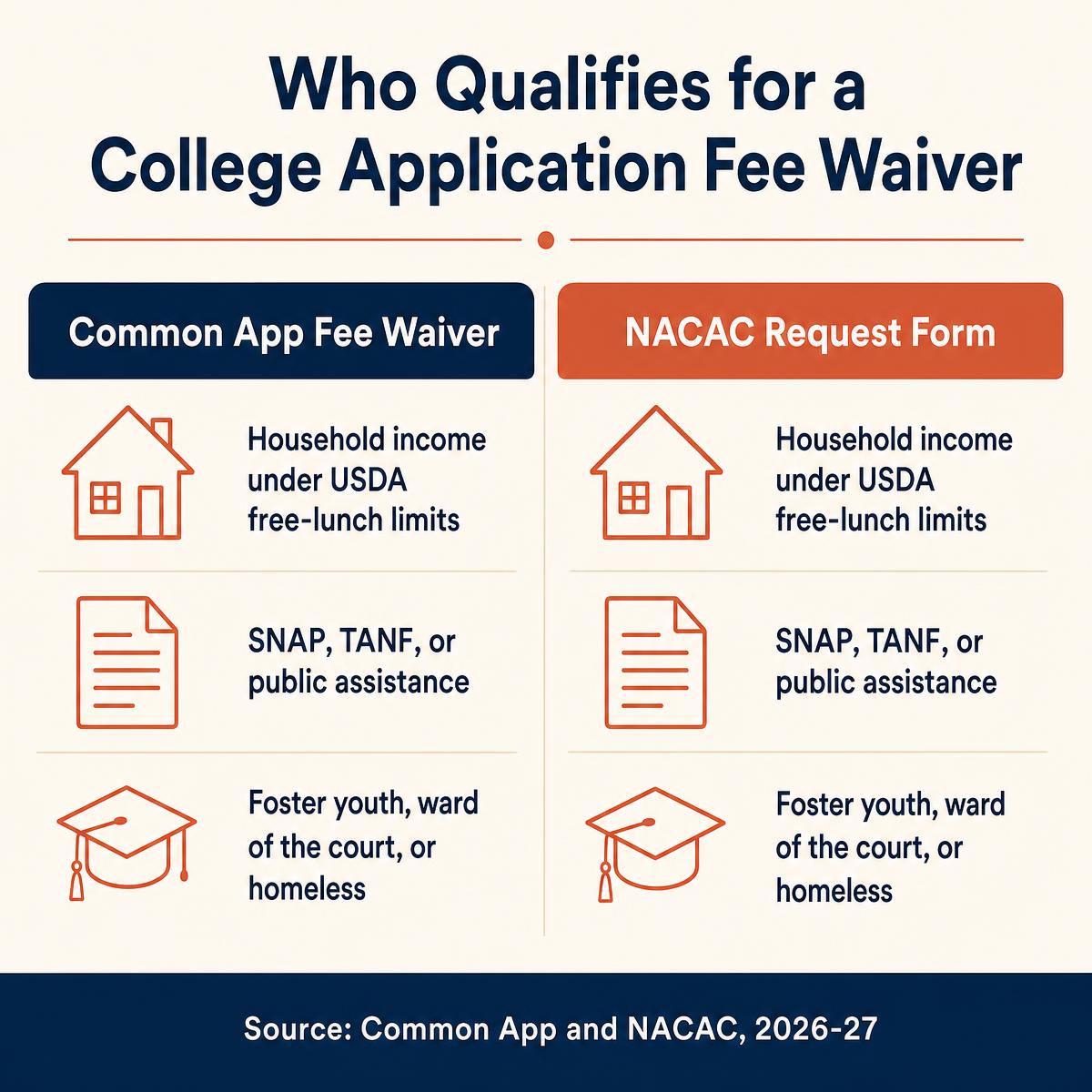
Eligibility is nearly identical across the Common App and NACAC forms. If a student meets any one of the criteria below, that student qualifies. Nothing has to be proven twice.
- The student has already received or is eligible to receive an SAT or ACT fee waiver.
- The student is enrolled in a federal, state, or local program that aids students from low-income families, including Federal TRIO programs such as Upward Bound.
- Family income falls within the USDA Income Eligibility Guidelines for free or reduced-price school lunch.
- The student is enrolled in or eligible to participate in the federal free or reduced-price lunch program at school.
- The family receives public assistance such as SNAP, TANF, or public housing.
- The student lives in federally subsidized public housing, a foster home, or is homeless.
- The student is a ward of the state or an orphan.
- The student can provide a supporting statement from a school official, college access counselor, financial aid officer, or community leader confirming financial need.
The Common App fee waiver: how it works
Inside the Common Application, the fee waiver lives in the Profile section under Common App Fee Waiver. A student self-attests to one of the eligibility criteria above by checking a box, and a counselor confirms it later through the school report. Per the Common App Student Solutions Center, no separate document upload is required at the time of application.
Once the box is checked, the Common App fee waiver applies automatically to every member college on the student's list. There is no cap on the number of schools. A student applying to twelve Common App schools with a waiver pays zero dollars in application fees at those twelve schools, provided the counselor confirms eligibility on the school report.
The NACAC form: how it works
The NACAC Request for Admission Application Fee Waiver is the standard paper form used by schools that do not accept the Common App or that ask for a separate signed form. The current fillable PDF is hosted at NACAC's site: NACAC 2024 Fee Waiver Fillable Form.
The student fills out the top section, a school counselor or authorized official signs the certification, and the completed form goes directly to each college's admissions office. One NACAC form covers one college, so students applying to five schools this way submit five separate forms. Almost every four-year college in the U.S. accepts the NACAC form.
SAT and ACT fee waivers unlock college fee waivers automatically
This is the pathway most families miss. A student who took the SAT with a fee waiver, or was flagged as fee-waiver-eligible through a district or state program, automatically receives college application fee waivers usable at more than 2,000 participating colleges. The full policy is on the College Board SAT fee waiver page and the BigFuture college fee waiver FAQ.
The waivers are delivered inside the student's College Board account and can be used online at the participating school's application portal. ACT offers the same benefit for students who took the ACT with a fee waiver. If a rising senior took either test with a fee waiver, no additional paperwork is needed at all.
College-specific waivers you should still ask for
Even outside the Common App and NACAC systems, hundreds of colleges quietly waive their application fee on request. Three specific situations are almost always covered.
- The student visited campus or attended an official virtual info session. Many admissions offices issue a fee waiver code to visitors as a standard practice.
- The student applied Early Action or Early Decision by the school's priority deadline. Some flagships and mid-size privates waive the fee automatically for early applicants.
- The student meets the school's stated financial need criteria. Every college has a financial hardship pathway. If none of the standard boxes fit, email the admissions office directly and ask what documentation is required.
Documents to pull this week
The paperwork behind a fee waiver is short. Pulling it into one folder now means every waiver request in September and October takes minutes, not hours.
- Most recent household federal tax return, usually the 2024 return for 2026-27 applications.
- Proof of SNAP, TANF, WIC, or public housing enrollment if applicable: a benefits letter or EBT card copy is enough.
- Proof of free or reduced-price school lunch enrollment: the school district can print this in one page.
- A copy of the student's SAT or ACT fee waiver confirmation if applicable.
- The name and email of the school counselor or authorized official who will sign the NACAC form.
- A one-paragraph financial hardship statement in the student's own words, dated and signed, kept on file for schools that ask for one.
What a fee waiver does not cover
The waiver removes the application fee. It does not remove anything else in the enrollment funnel. Families should plan for four other costs that arrive later.
- Enrollment deposit at the school the student commits to: usually 200 to 800 dollars, due by May 1.
- Housing deposit at residential colleges: usually 200 to 500 dollars, sometimes due earlier than the enrollment deposit.
- CSS Profile fee at schools that require it: 25 dollars for the first school and 16 dollars per additional school, though CSS Profile has its own automatic waiver for lower-income U.S. students. See the CSS Profile vs FAFSA guide for who qualifies.
- Official transcript and test score fees from the high school and testing agencies, which have their own waiver systems.
Timing: what to do before August 1
The Common Application opens August 1, 2026, for the Class of 2027. Fee waiver setup takes fifteen minutes once the account exists, but only if the account and the documentation exist first. Between now and August 1, three actions matter most.
- Create the Common App account this week if the student has not already. Fill out the Profile section, including the Common App Fee Waiver question.
- Confirm with the school counselor which authorized official signs the NACAC form and how they prefer to receive waiver requests. Most counselors handle dozens each fall and appreciate a heads-up in July.
- For each school on the student's locked list, check the admissions website for a school-specific waiver policy. Log which pathway each school accepts in one spreadsheet so nothing gets billed by mistake in October.
How this fits the rest of senior year
Waiving application fees is one piece of the affordability picture, not the whole picture. Net price, institutional grant aid, and outcomes after graduation matter far more than the 75-dollar application fee. Use UniScorecard's school search and side-by-side compare to confirm federal net price at every school on the list, and pair the waiver work with financial aid prep using the FAFSA 2026-27 deadlines guide and the senior summer college application checklist.
For families deciding whether the application list is realistic at all, the balanced college list guide walks through how to split reach, target, and likely schools so the waiver dollars land where they matter.
The bottom line
A fee waiver is not a favor. It is a documented policy the Common App, NACAC, the College Board, and individual colleges have written into their admissions systems to make sure cost does not decide who applies. If a student meets any one of the eligibility criteria above, the waiver is the student's to claim. The only wrong move is applying and paying because no one told the family the option was there.
How to get a fee waiver for college applications
The exact steps depend on which pathway you use, but the sequence is the same everywhere: confirm eligibility, gather proof, submit the waiver before you pay the application fee, and keep a copy of the confirmation.
- Common App: check the fee waiver box in the Profile section, then ask your counselor to confirm it on the school report. The waiver applies to every Common App school on your list automatically.
- NACAC: download the fillable PDF, complete the student section, have an authorized school official sign it, and email or upload it to each college's admissions office before submitting the application.
- SAT/ACT waiver: log into your College Board or ACT account and look for the college application fee waiver section. Use the codes at participating schools during checkout.
- School-specific: email the admissions office before the deadline and ask for a financial hardship or visit-based waiver code.
Further reading
On UniScorecard
- FAFSA 2026-27 deadlines guide
Federal aid deadlines that pair with fee waiver planning for the Class of 2027.
- CSS Profile vs FAFSA
Which schools also require the CSS Profile, plus its own automatic fee waiver.
- How to pay for college
The full stack of grants, scholarships, loans, and work-study.
- Senior summer college application checklist
Weekly summer plan for Class of 2027 that slots fee waiver requests in the right week.
- How to build a balanced college list
Confirm your list is realistic before waiving fees on twelve reaches.
- Financial aid award letter 2026
How to compare spring aid offers once applications and waivers are in.
- School search
Confirm federal net price and application fees at every school on the list.
- Side-by-side compare
Stack net price and outcomes for finalist schools before the waiver deadline hits.
External sources
- Common App: What is a Common App fee waiver ↗
Official Common App eligibility criteria and how to enable the waiver inside the application.
- NACAC application fee waivers ↗
Official NACAC fee waiver overview for first-time undergraduate applicants.
- NACAC Request for Admission Application Fee Waiver form ↗
The current fillable PDF form students and counselors send to each college.
- BigFuture college application fee waiver FAQ ↗
College Board explainer of the automatic SAT-to-application waiver at 2,000+ schools.
- SAT fee waivers ↗
Official SAT Suite fee waiver eligibility and what it unlocks beyond the test itself.
- Federal Student Aid: Pell Grant ↗
Federal Pell Grant eligibility, referenced by the NACAC transfer waiver form.
- Federal Student Aid: apply for FAFSA ↗
File the FAFSA in parallel with fee waiver requests once October 1 arrives.
- Common App first-year applicants ↗
Official Common App overview of the first-year application, including fees.
Related guides
Supplemental Essays: A Pre-August Plan for Class of 2027
How Class of 2027 applicants can inventory, schedule, and outline every college supplemental essay before Common App opens on August 1, 2026.
Common App Activities List: 10 Examples for 2026-27
10 Common App activities list examples showing how to order, quantify, and describe entries for the 2026-27 cycle, plus what readers look for.
Common App Additional Information: What to Write
Learn what belongs in the Common App additional information section, review clear examples, and use our practical September checklist before you submit.
Frequently asked
- Who qualifies for a college application fee waiver in 2026-27?
- Any student who has already received an SAT or ACT fee waiver, is enrolled in a program serving low-income families (including Federal TRIO), qualifies for free or reduced-price school lunch, whose family receives SNAP, TANF, or public housing, or who is a ward of the state, foster youth, homeless, or an orphan. A supporting statement from a school counselor also qualifies a student.
- How do I request a Common App fee waiver?
- Inside the Common Application, go to the Profile section and answer the Common App Fee Waiver question. Check the box that applies, then submit. The school counselor confirms eligibility later through the school report. The waiver then applies automatically to every member college on the list.
- Do I need a separate fee waiver for each college?
- No for Common App member colleges: one Common App fee waiver covers every Common App school on the list. Yes for non-Common App schools using the NACAC form: one NACAC form covers one college, so submit one form per school.
- Does an SAT fee waiver mean my college applications are free?
- At participating schools, yes. Students who took the SAT with a fee waiver receive college application fee waivers usable at more than 2,000 participating colleges. The waivers appear inside the student's College Board account and apply during the application submission step.
- What if my situation does not match the standard eligibility list?
- Contact the admissions office at each school and ask about a financial hardship waiver. Every college has a pathway; most simply require an email from a counselor or a short student-written hardship statement. Do this before submitting the application, not after paying.
About the author
UniScorecard Editorial
Higher-education data team
We translate the U.S. Department of Education's College Scorecard into plain-language guides for students, families, and counselors. Every metric we publish is sourced directly from the federal Most Recent Cohorts institutional file.
Read our methodology →