Common App Activities List: 10 Examples for 2026-27
The Common App activities list is ten rows, 150 characters of role and organization, and 150 characters to describe what you actually did. It is the second most read part of a college application after the essay, and it is the section most students get wrong by treating it like a resume dump. The fix is not to do more activities the summer before senior year. The fix is to write the ten entries you already have in a way an admissions reader can scan in under a minute and still come away knowing what you led, what you built, and what you cared about. This guide is the structure, the verb list, and the worked examples a rising senior reading this on June 30, 2026 can use this week, before the Common App opens August 1.
Higher-education data team
Sources: Sourced from the Common Application's published activities section requirements, the National Association for College Admission Counseling (NACAC) State of College Admission report, the College Board's Big Future apply hub, and the published first-year application instructions of more than fifteen four-year U.S. colleges including MIT, Johns Hopkins, the University of Michigan, the University of Virginia, Georgetown, and the University of California system..
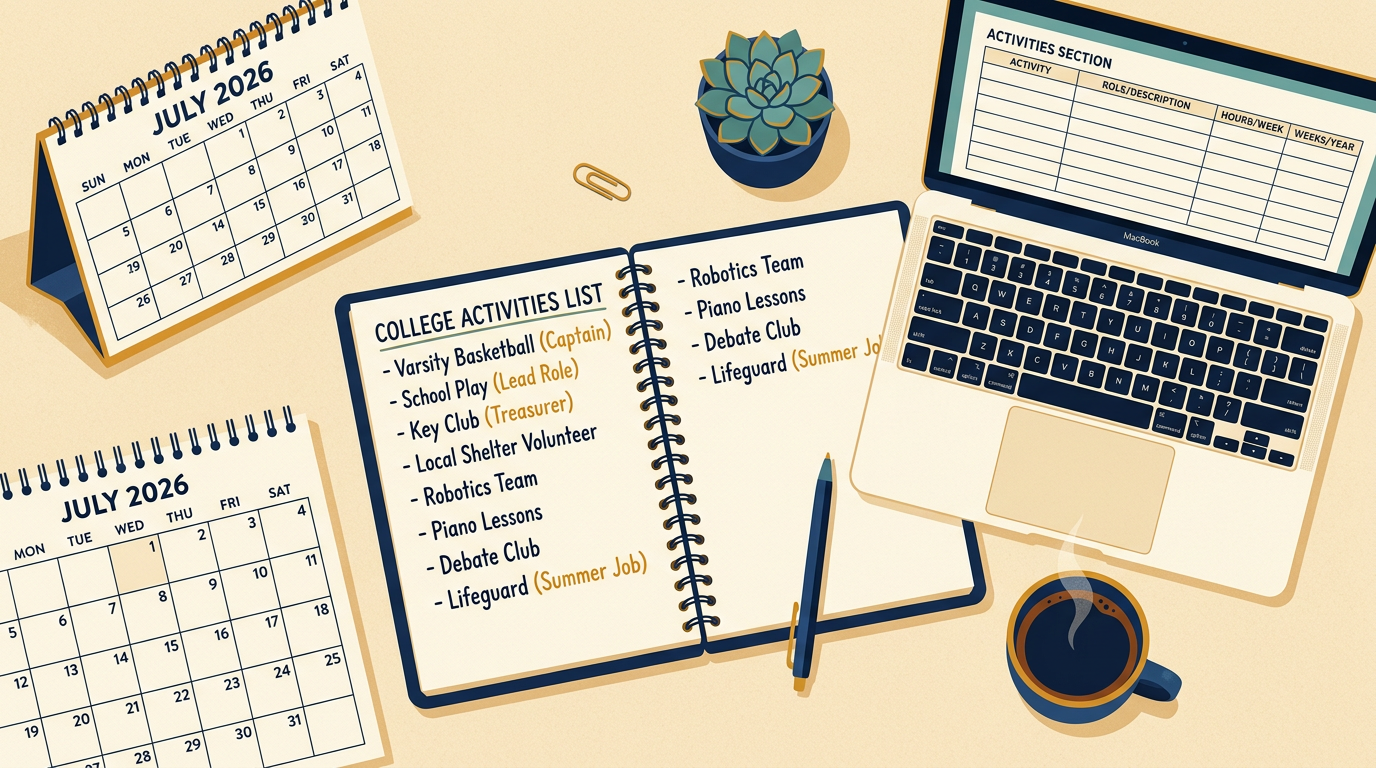
What the activities section actually is
The Common Application gives every applicant exactly ten activity slots. Each slot has a fixed structure: an activity type from a preset list, a position or leadership title (50 characters), the name of the organization (100 characters), a description of what you did (150 characters), the grade levels involved, the timing inside or outside the school year, the hours per week, and the weeks per year. There is no eleventh slot, no attached resume in the main application, and no separate file upload for a portfolio.
The implication is the part most families miss. Admissions readers at a selective college spend somewhere between six and twelve minutes on a full application. The activities section gets ninety seconds of that, and a reader is scanning for three things: what you actually did, how much you did it, and whether you led anything. A row that is vague about any of those three loses the row.
Pick the ten before you write any of them
Most students start by writing the first activity and stop at row four. The better order is the opposite. List every activity, job, family responsibility, club, sport, research project, and creative pursuit from ninth grade through summer before senior year on one page. Then pick the ten that go on the application. Cutting from twenty down to ten is what makes the list feel intentional instead of padded.
- Include paid work, including fast food and retail. The Common App lists "Work (Paid)" and "Family Responsibilities" as activity types for a reason, and selective colleges read them as signals of responsibility, not weakness.
- Include family responsibilities such as caring for siblings, translating for a parent, or running a household task that takes real weekly hours.
- Include any role you held for two or more years. Sustained commitment is the single strongest signal in a short list.
- Include any activity where you held a title, led a team, founded the thing, or built the thing.
- Cut activities you did only in ninth grade and never again. They take a slot that a more recent commitment deserves.
- Cut one-off events such as a single weekend service trip. Group them under a broader umbrella activity if they belong to one.
Order the list by what matters most to you
The Common App does not require chronological order, and you should not use it. Order the ten activities by importance to you, from most to least, because the first three rows get the most reader attention and the last two often get a quick glance. The top of the list should be the activity you would defend in an interview, not the one with the most years on it.
A reasonable test: if an admissions officer read only the first three rows, would they get the right impression of who you are as a student? If the answer is no, the order is wrong. Move the activity that defines you to row one even if you have done it for fewer years than something further down.
How to write the position and organization fields
The position field is 50 characters. The organization field is 100 characters. These are not throwaway lines. They are the first thing a reader sees and they should answer two questions immediately: what is your role, and what is the thing.
- Lead with the title, not the activity. "Captain, Varsity Soccer" reads stronger than "Soccer Player, Varsity Team" because the reader's eye lands on the leadership word first.
- Use the real title, not an inflated one. If you were a member, say member. "Founding Member" and "President" mean different things and admissions readers know which clubs at which schools elect presidents.
- Spell out the organization on first reference and use a recognized acronym only if it is genuinely well known. "DECA" and "FBLA" are fine. A local club acronym is not.
- Include the level: varsity vs junior varsity, regional vs national, school chapter vs national organization. Level is data.
- Skip the city and state unless the activity is geographically specific and unusual, such as "Volunteer, Brooklyn Public Library Teen Tech Lab."
How to write the 150-character description
This is the field that decides whether the row works. You have 150 characters, including spaces, to describe what you did. Treat it as one or two phrases, not a sentence with a subject. Drop the personal pronouns, lead every clause with a strong verb, and quantify whatever can be counted.
- Lead with a verb. "Led," "founded," "managed," "taught," "raised," "built," "coded," "produced," "coached," "organized," "trained." Strong verbs do the work that adjectives cannot.
- Quantify the role. Numbers do more in 150 characters than adjectives ever can. "Coached 18 first-graders" beats "Coached many young students."
- Name the outcome. "Raised $4,200" or "Grew membership from 12 to 38" or "Placed second at state" tells the reader what changed because you were there.
- Stack two clauses with a semicolon when one verb does not capture the role. "Founded coding club; taught Python to 22 ninth-graders across 14 weekly sessions."
- Skip filler such as "responsible for," "in charge of," or "helped with." They eat characters and say almost nothing.
- Use plain abbreviations only where readers will understand them: hrs, wk, yr, vs, mo. The Common App does not penalize abbreviations and they buy characters.
Two worked examples: weak versus strong
The fastest way to see the difference is to rewrite a real entry. Both versions below describe the same activity. The first is what most students submit on the first draft. The second is what the same activity becomes after a careful rewrite.
- Weak: Position "Member," Organization "Student Government," Description "Helped plan events and worked with other students on different activities throughout the school year."
- Strong: Position "Treasurer," Organization "Student Government (elected, grades 11-12)," Description "Managed $12K annual budget across 14 events; cut printing costs 22% by switching to digital tickets."
- Weak: Position "Volunteer," Organization "Local Animal Shelter," Description "Volunteered at the shelter and helped with the animals and worked on adoption events."
- Strong: Position "Adoption Volunteer," Organization "County Humane Society," Description "Walked 8-12 dogs weekly; trained 6 new volunteers; staffed 9 weekend adoption events placing 31 animals."

How to report hours per week honestly
The hours per week and weeks per year fields are the part of the application most students inflate, and the part most counselors warn against. Admissions readers compare hour counts across thousands of applications and a row that claims 30 hours per week of an activity that meets twice a week reads as a credibility problem on the whole list.
Use the average across the active period, not the peak week. A varsity sport is usually 12 to 20 hours per week during season and 0 to 5 in the off-season, so report the in-season number and use the weeks-per-year field to show the season length. A part-time job is genuinely 15 to 25 hours per week in summer and 6 to 12 during school. Report the truth, and use the timing checkboxes ("during school year," "during break") to show the pattern.
Use all ten slots, or do not
There is no penalty for using fewer than ten activity slots. There is a real cost to padding the last three rows with one-line entries that read as filler. If your ninth and tenth strongest activities are weaker than the first eight, the application reads stronger with eight strong rows than ten uneven ones.
That said, most students underestimate what counts. Family responsibilities, paid work, independent creative projects, and self-taught skills with measurable output all count. A student who runs a small Etsy shop, codes a side project on GitHub, manages a sibling pickup schedule, or holds a regular shift at a parent's business has activities worth a row. The NACAC State of College Admission report consistently lists work experience and family responsibility among the factors selective colleges weigh, even when they are not formal extracurriculars.
What to do this week
It is the last day of June 2026. The Common App opens August 1. A rising senior who spends four hours on the activities list this week will save twenty hours of rewrites in October.
- List every activity, job, family responsibility, and creative project from ninth grade through this summer on a single page.
- Cut the list to ten. Order them by importance to you, not chronology, with the most defining activity in row one.
- Draft the 150-character description for each row using a strong leading verb and at least one quantified number.
- Pull each row's hours per week and weeks per year from a real calendar or a recent pay stub, not a memory.
- Share the draft with a teacher or counselor in the first week of August for one round of edits before the Common App goes live.
- Pair the activities list with the senior summer college application checklist and the Common App essay prompts guide so the whole application moves together.
Where the activities list fits in the full application
Admissions readers cross-check the activities list against the essay, the recommendation letters, and the school's transcript. A row that claims a leadership title should appear in the counselor letter. An activity that anchors the essay should sit in the top three rows of the list. A summer commitment described in a supplemental essay should show up with realistic hours and weeks. Consistency across the three sections is what makes the application read as one person.
Before the application is submitted, run one last pass. Pull the school's data on UniScorecard's school search and the side-by-side compare tool to confirm fit, then read the activities list out loud. Anything that reads as filler probably is. Cut it, or rewrite it so the verb is stronger and a number is in the line.
How many activities can you list on the Common App?
The Common App allows up to ten activity slots. You do not have to use all ten. Eight strong, specific entries usually read better than ten rows that include filler. Most successful applicants at selective colleges list between seven and ten activities.
How to list activities on the Common App
Each row has a fixed structure: activity type, position or leadership title, organization name, 150-character description, grade levels, timing, hours per week, and weeks per year. Order the rows by importance to you, not by chronology.
- Lead the position field with your actual title, such as Captain, Founder, or Treasurer.
- Use the organization field to name the group and its level, such as Varsity Soccer or County Humane Society.
- Write the description as verb-first phrases with at least one number: people, dollars, hours, or events.
- Report honest hours and weeks; inflated numbers hurt credibility.
- Place the activity that best represents you in row one.
Activities list examples that work
Below are three more strong entries that show different activity types. Each uses a strong verb, a number, and a clear outcome in 150 characters or less.
- Position: Tutor, Organization: Peer Math Tutoring Program, Description: Tutored 12 ninth-graders weekly in algebra; raised average quiz scores 14 points over one semester.
- Position: Social Media Lead, Organization: Environmental Club, Description: Ran Instagram and TikTok accounts; grew followers from 80 to 1,200 and promoted 6 campus cleanups.
- Position: Line Cook, Organization: Local Family Restaurant, Description: Worked 20 hrs/wk during school year; trained 3 new hires and managed closing register on weekend shifts.
Further reading
On UniScorecard
- Senior summer college application checklist
Week-by-week summer plan the activities list slots into.
- Common App essay prompts 2026-27
How the essay should reinforce the top rows of the activities list.
- How to ask teachers for letters of recommendation
Build the brag sheet for recommenders alongside the activities list.
- Early Decision vs Early Action 2027
Application timing that shapes when the activities list has to be final.
- How to compare colleges
Federal data check to run on every school on the final list.
- School search
Verified outcomes for every Title IV institution on the application list.
- Side-by-side compare
Stack schools on graduation rate, net price, and earnings before applying.
External sources
- Common Application first-year students ↗
Official first-year application overview including the activities section.
- Common App explore ↗
Member college list with application requirements and supplements.
- NACAC research ↗
State of College Admission reports on how admissions readers weigh activities.
- College Board Big Future apply ↗
Application planning guidance from the College Board.
- College Scorecard ↗
Federal source for graduation rate, net price, and median earnings by school.
- College Navigator ↗
Admissions, retention, and selectivity data from the National Center for Education Statistics.
Related guides
Supplemental Essays: A Pre-August Plan for Class of 2027
How Class of 2027 applicants can inventory, schedule, and outline every college supplemental essay before Common App opens on August 1, 2026.
How to Get College Application Fee Waivers in 2026-27
See who qualifies for college application fee waivers in 2026-27, how to request them through Common App and NACAC, and what paperwork to gather before August 1.
How to Build a Balanced College List (Class of 2027)
A data-driven method for building a balanced college list of 8 to 12 schools before August 1: reach, target, and likely tiers with real federal numbers.
Frequently asked
- How many activities should I list on the Common App?
- Up to ten, in order of importance to you rather than chronology. There is no penalty for listing fewer if your strongest activities run out before row ten. Eight strong rows read better than ten uneven ones. Most selective applicants use between seven and ten slots.
- Do paid jobs count as activities on the Common App?
- Yes. The Common App lists "Work (Paid)" as an activity type and selective colleges read paid work, including retail and food service, as a signal of responsibility and time management. Family responsibilities such as caring for siblings or translating for a parent also have their own activity type and should be included.
- What should I write in the 150-character activity description?
- Lead with a strong verb such as led, founded, taught, managed, or coached. Drop personal pronouns and filler phrases such as "responsible for." Quantify the role with real numbers (hours, dollars raised, people coached, events run) and name the outcome where one exists. Two clauses joined by a semicolon often fits more than one full sentence.
- Is it okay to use abbreviations in the Common App activities list?
- Yes. The Common App does not penalize abbreviations and the character limits make them necessary. Use common ones such as hrs, wk, yr, vs, and mo. Spell out the organization name on first reference and only use an acronym if it is genuinely well known nationally or in your field.
- Should I inflate my hours per week to look more impressive?
- No. Admissions readers compare hour counts across thousands of applications and an inflated number on one row casts doubt on the whole list. Report the honest average across the active period and use the timing checkboxes to show whether the activity runs during the school year, on breaks, or both.
About the author
UniScorecard Editorial
Higher-education data team
We translate the U.S. Department of Education's College Scorecard into plain-language guides for students, families, and counselors. Every metric we publish is sourced directly from the federal Most Recent Cohorts institutional file.
Read our methodology →