Why This College Essay: How to Write One That Wins
The Why This College essay is the supplemental question that decides more borderline admissions cases than any other. It is short, usually 150 to 400 words, and it is the one place in the application where an admissions reader finds out whether you actually know what you are applying to. Generic answers get generic outcomes. A specific answer, built on real research into a real program, is what turns a maybe into an admit. This guide is the research method, the paragraph structure, and the worked examples a rising senior reading this on July 1, 2026 can use this week, before most Common App supplements open August 1.
Higher-education data team
Sources: Sourced from the Common Application's published supplement guidance, the NACAC State of College Admission report on essay weight in admissions decisions, and the published supplemental essay prompts of more than twenty selective U.S. colleges including MIT, Yale, Princeton, Johns Hopkins, the University of Michigan, Tufts, Rice, and the University of North Carolina..
What admissions readers are actually checking
The Why This College prompt goes by many names. Yale calls it "What is it about Yale that has led you to apply?" Tufts asks "Why Tufts?" Michigan asks about the specific school or college within the university. The wording changes. The job of the essay does not. An admissions officer is reading it to answer one question: did this student do the work to figure out whether we fit them, or did they paste our name into a form?
That question matters because yield, the share of admitted students who enroll, is the single number that most shapes admissions decisions after academic fit. A well-researched supplement is the clearest signal a reader has that an applicant will show up in September if admitted. According to the NACAC State of College Admission report, demonstrated interest and application essays are consistently ranked among the top non-academic factors selective colleges weigh, and the Why This College supplement is where both signals live at once.
Start with an hour of real research, not a draft
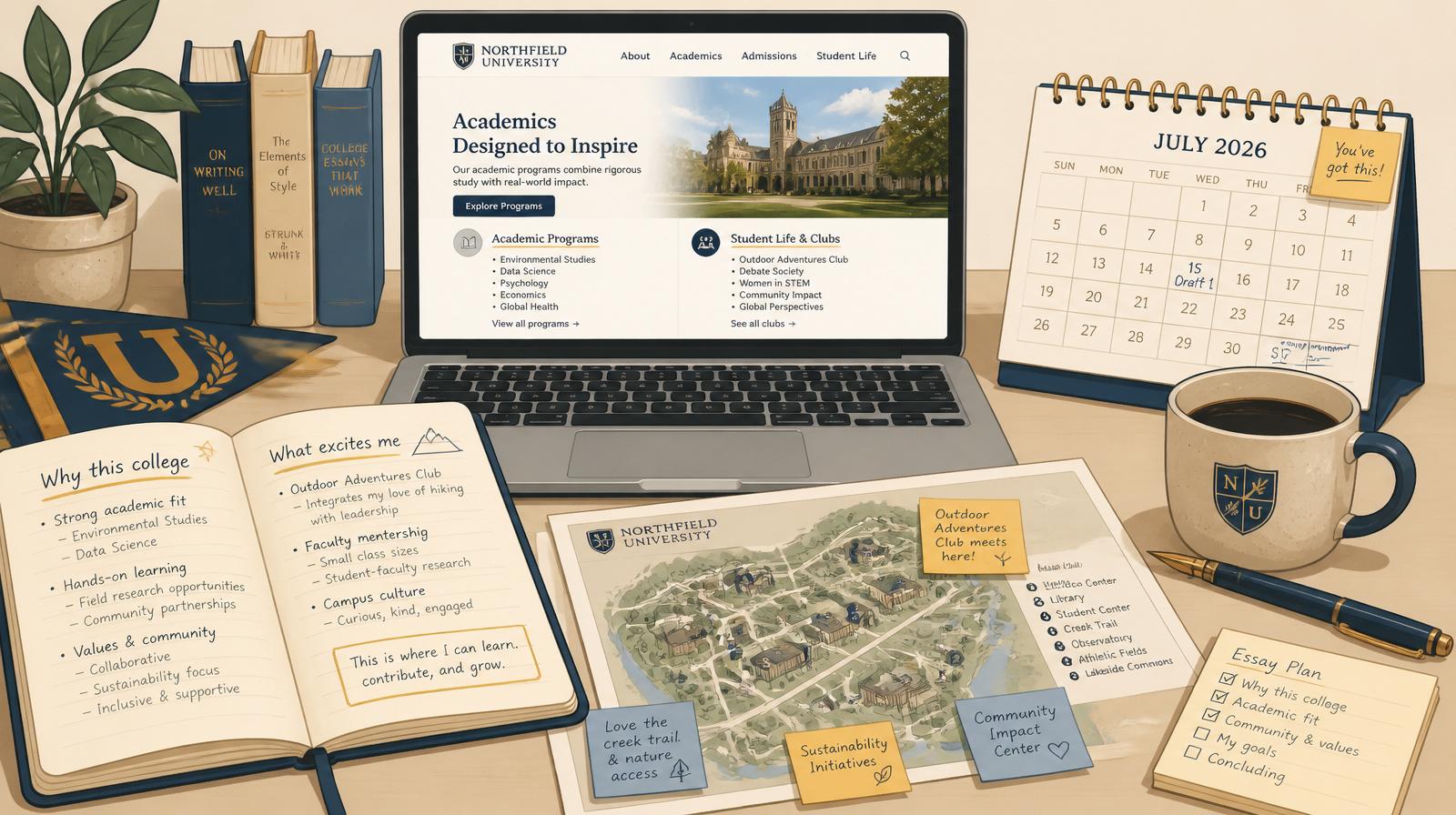
The most common mistake is opening a document and starting to write. The draft that follows is almost always a rewrite of the college's marketing copy in the student's voice. The better first step is a research pass with no essay involved. Give one hour per school. Take notes in a plain document with the school's name at the top.
- Open the academic department page for the major you plan to declare. Write down two specific courses by number and title that you want to take, and one professor whose research overlaps with something you have already done.
- Open the student activities directory. Write down one club or organization you would join in the first month and one you would consider founding or contributing to by junior year.
- Open the campus news site or student newspaper. Write down one story from the last twelve months that tells you something about the culture, not the rankings.
- Open the school's core curriculum or general education requirements. Write down one requirement that appeals to you and one that will stretch you outside your strongest subject.
- Skim the school's mission statement or strategic plan. Write down one sentence that connects to a value you already hold, in your own words, not theirs.
- Note one campus tradition, place, or program that only exists at this school. A tradition is a fingerprint no other supplement can copy.
The structure that works for almost every prompt
Once the research is on the page, the essay writes faster because the specifics are already there. A reliable structure fits nearly every version of the prompt, from a 100-word short answer to a 400-word essay.
- Open with a specific hook: a course, a lab, a class discussion you can already picture yourself in. Skip the tour anecdote and skip the "ever since I was young" opener.
- Connect the academic specifics to what you have already done. One or two sentences on the class or project in high school that made this program the right next step.
- Name one community you will join and what you will bring to it. A club, a residential college, a research group, a performing ensemble, a service program.
- Name one campus tradition, place, or program that only exists here and put yourself inside it in one sentence.
- Close with a forward line on what you plan to do with the education, tied to a specific program or resource on campus. Skip the "I hope to make a difference" close.
Two worked examples: generic versus specific
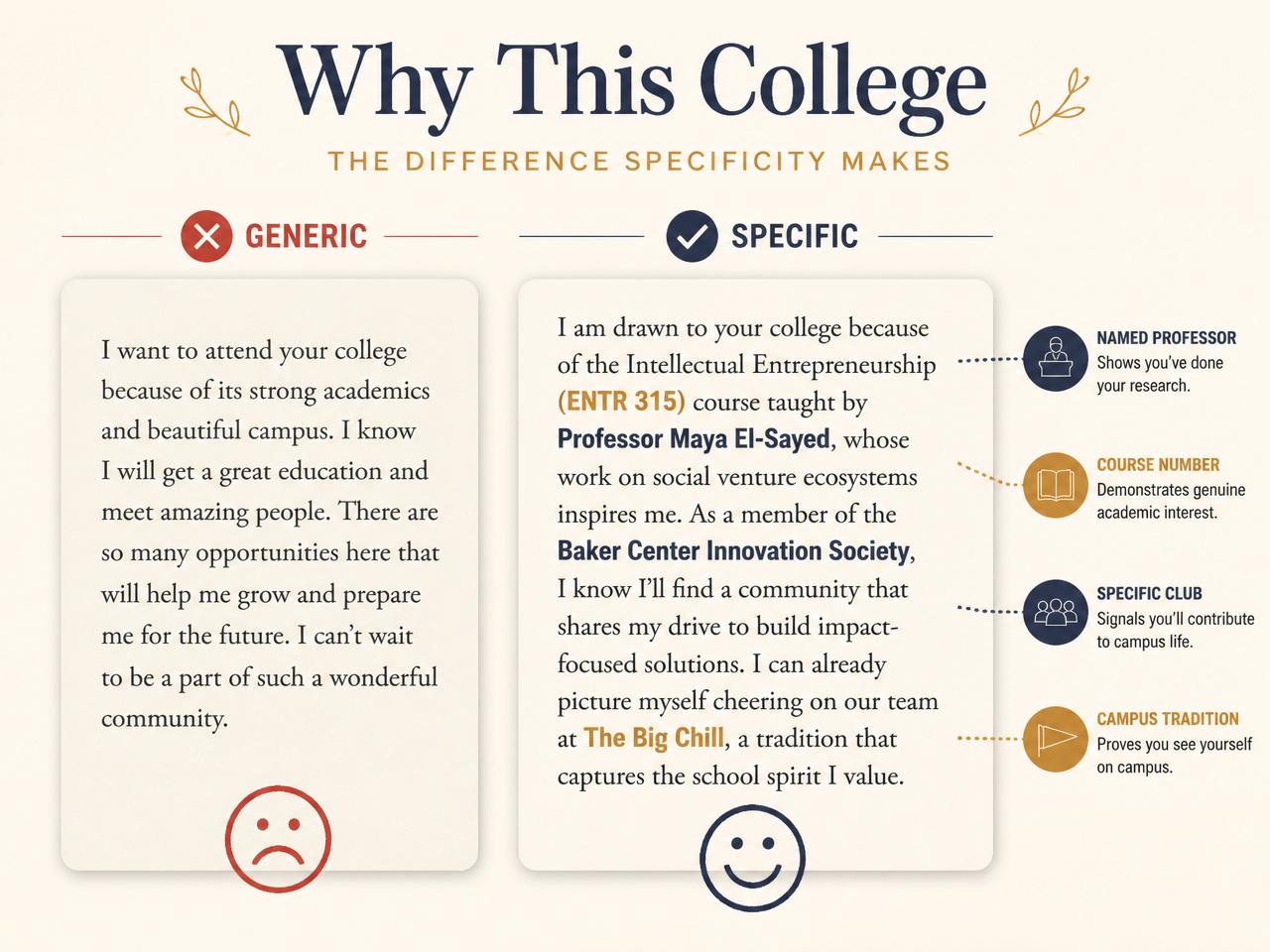
The fastest way to see the difference is a side-by-side. Both versions below answer the same 150-word Why This College prompt. The first is what most first drafts look like. The second is what the same paragraph becomes after one hour of research and one rewrite.
- Generic: I want to attend your college because of its strong academics and beautiful campus. I know I will get a great education and meet amazing people. There are so many opportunities here that will help me grow and prepare me for the future. I cannot wait to be a part of such a wonderful community.
- Specific: I am drawn to your college because of the Intellectual Entrepreneurship course (ENTR 315) taught by Professor Maya El-Sayed, whose work on social venture ecosystems overlaps with the microloan project I ran in tenth grade. As a member of the Baker Center Innovation Society I will find a community that shares my drive to build impact-focused solutions, and I can already picture myself at The Big Chill, the campus tradition that captures the school spirit I want.
What to cut from every draft
Most Why This College essays are too long by a third because they carry sentences that could describe any school. Pull those sentences out and the essay gets stronger without a rewrite.
- Rankings, prestige language, and any variation of top-ranked, world-class, or renowned. If the sentence would still be true swapped into another school's supplement, cut it.
- The weather, the food, the beauty of the campus, and the friendliness of tour guides. These are consumer reactions, not reasons to admit.
- Any sentence that describes what the school offers without connecting it to what you will do with it. "They have a great study abroad program" is not a Why This essay sentence; "I want to spend a semester at their Rome campus studying archaeology under Professor Chen" is.
- Backstory that belongs in the Common App personal essay. This supplement is about the fit, not the origin story.
- Praise for the interviewer, the tour guide, or the current students you met. Save it for the thank-you note.
How to research when you have not visited
A visit is helpful but not required, and admissions readers know most applicants cannot travel to every school on their list. The research substitutes for a visit if you use the right sources. The published federal data on College Scorecard and College Navigator tells you the size, majors offered, graduation rate, and net price. The school's own site tells you the culture, the programs, and the traditions. UniScorecard's side-by-side compare tool stacks the federal outcomes for up to four schools at once so you can confirm that the school you are writing about actually fits your academic profile before you spend an hour on the supplement.
- Read three student blog posts or student newspaper features. Student voices name traditions, complaints, and inside references that no viewbook mentions.
- Watch two student-produced YouTube videos, not the official admissions video. The tour a current junior films on their phone is closer to the campus you will actually live on.
- Follow the school's academic department on X, Instagram, or LinkedIn for two weeks. Recent posts reveal what the department is actually working on and hiring for.
- Attend one virtual information session hosted by the specific school within the university, not just the general admissions office. The engineering info session at Cornell is a different room than the Arts and Sciences session.
- Book a fifteen-minute call with a current student through the school's official ambassador program. One good call replaces four hours of website reading.
The length rules per school
Length varies more than most students expect. Write to the exact limit, not under it, because a short answer to a Why This prompt reads as low interest. If a school gives 250 words, use 240 to 250. If a school gives 100 words, use every one of them and make each carry weight.
- MIT breaks the Why MIT question into short-answer style prompts capped near 200 characters each. Every sentence has to be specific to survive. See the MIT short answer questions.
- Yale gives about 125 words for its Why Yale answer and expects specifics on programs and community. See the Yale essay topics.
- The University of Michigan asks a Why Michigan style question capped near 550 words, which is closer to a full essay than a paragraph.
- Tufts, Rice, and the University of North Carolina all fall in the 200 to 300 word range. Treat these as the standard middle case.
- A handful of schools including Harvard leave the Why prompt optional or fold it into other supplements. See the Harvard first-year applicants page for the current supplement list.
How to reuse research without copying essays
A typical selective list has six to twelve schools with a Why This supplement. Rewriting from scratch every time is what causes senior year burnout in November. The move is to reuse research, not sentences.
Keep one research document per school. Keep a second document that lists the shared themes across your list, such as the type of academic community you want or the kind of research you plan to do. Each supplement pulls from the shared themes document for the connective tissue and from the school-specific document for the named courses, professors, clubs, and traditions.
One test catches recycled essays before they go out. Read the draft with the school name replaced by a blank. If it still makes sense as a Why This essay for any other school on the list, the essay is not specific enough. A working Why This essay collapses if you pull the school name out.
The July 2026 timeline for the Why This essay
It is the first day of July. The Common App opens August 1. Most member colleges post supplemental essays between August 1 and mid-September. A rising senior who front-loads the research this month writes better essays in less total time.
- First week of July: finalize the college list to no more than twelve schools. The research load doubles at fifteen and quality drops.
- Second and third weeks of July: one hour of structured research per school using the checklist earlier in this guide. Save each set of notes in its own document.
- Fourth week of July: draft one Why This essay for a mid-list school, not a top-choice school. First drafts on a lower-stakes essay are faster and teach the structure.
- First week of August: rewrite the top-choice Why This essay using the mid-list draft as the pattern. Share it with one teacher or counselor for a single round of edits.
- Rest of August and September: work through the remaining supplements at two per week, not two per night. Sustainable pace beats deadline pace on quality.
- Pair this timeline with the senior summer college application checklist and the Common App essay prompts guide so the whole application moves together.
Where the Why This essay fits in the full application
The Why This College supplement does not stand alone. It is read alongside the Common App essay, the activities list, and the transcript, and it should reinforce the story those three tell. If your activities list shows leadership in student government, the Why This essay should name the on-campus civic engagement center you plan to join. If your transcript is heavy in biology, the Why This essay should name a lab, a professor, or a course that continues that path. Consistency across the four sections is what makes the application read as one person.
Before you write the essay, run one federal-data check on the school. Pull the graduation rate, net price, and median earnings on UniScorecard's school search and the side-by-side compare tool. If the data does not match what you want out of college, the essay will be hard to write for a reason: the school is not the right fit. Better to catch that in July than in April.
Further reading
On UniScorecard
- Senior summer college application checklist
Week-by-week summer plan the Why This essay slots into.
- Common App essay prompts 2026-27
How the personal essay and the Why This supplement should reinforce each other.
- Common App activities list guide
The activities list your Why This essay should echo, not repeat.
- How to ask teachers for letters of recommendation
Recommenders should reinforce the fit the supplement claims.
- Early Decision vs Early Action 2027
Application timing that shapes when the top-choice Why This essay has to be final.
- How to compare colleges
Federal data check to run on every school before writing the essay.
- School search
Verified outcomes for every Title IV institution on the application list.
- Side-by-side compare
Stack schools on graduation rate, net price, and earnings before writing the supplement.
External sources
- Common Application first-year students ↗
Official first-year application overview including member school supplements.
- NACAC research ↗
State of College Admission reports on how essays and demonstrated interest weigh in decisions.
- MIT short answer questions ↗
Example of a short-answer Why prompt with tight character limits.
- Yale essay topics ↗
Example of a mid-length Why This College prompt from a selective university.
- Harvard first-year applicants ↗
Reference for a supplement list without a standard Why prompt.
- College Scorecard ↗
Federal source for graduation rate, net price, and median earnings by school.
- College Navigator ↗
Admissions, retention, and program data from the National Center for Education Statistics.
Related guides
Supplemental Essays: A Pre-August Plan for Class of 2027
How Class of 2027 applicants can inventory, schedule, and outline every college supplemental essay before Common App opens on August 1, 2026.
How to Build a Balanced College List (Class of 2027)
A data-driven method for building a balanced college list of 8 to 12 schools before August 1: reach, target, and likely tiers with real federal numbers.
Common App Activities List: 10 Examples for 2026-27
10 Common App activities list examples showing how to order, quantify, and describe entries for the 2026-27 cycle, plus what readers look for.
Frequently asked
- How long should a Why This College essay be?
- Write to the exact word limit the school posts, not under it. A short answer to a Why This prompt reads as low interest to admissions readers. Most schools give between 150 and 400 words, with a handful of short-answer variants at 100 words or less and a few full-length essays near 550 words. Use 95 to 100 percent of the limit for every school.
- Should I name specific professors and courses in the essay?
- Yes. Named professors, course numbers, specific labs, and specific clubs are the details that separate a researched supplement from a generic one. One named professor whose work overlaps with something you have already done is stronger than three vague references to the strength of the department.
- Can I reuse a Why This essay across multiple schools?
- You can reuse research and structure, but never sentences that name programs, courses, or traditions. The clearest test is to read the essay with the school name replaced by a blank. If it still works for any other school on your list, the essay is not specific enough and admissions readers will notice.
- Do I have to visit the campus to write a good Why This essay?
- No. A visit helps but is not required. Student newspaper articles, current student blogs, virtual information sessions hosted by the specific school within the university, and a fifteen-minute call with a student ambassador can replace a visit for the purpose of the essay. The federal data on College Scorecard and College Navigator confirms fit on the numbers.
- What should I avoid in a Why This College essay?
- Cut ranking language, praise for weather or campus beauty, backstory that belongs in the personal essay, and any sentence that would still be true if you swapped in another school's name. Also cut the closing line about wanting to make a difference. Replace it with a forward sentence that names a specific program or resource you plan to use.
About the author
UniScorecard Editorial
Higher-education data team
We translate the U.S. Department of Education's College Scorecard into plain-language guides for students, families, and counselors. Every metric we publish is sourced directly from the federal Most Recent Cohorts institutional file.
Read our methodology →