Common App Essay Prompts 2026-27: How to Pick Yours
The Common Application opens for the 2026-27 cycle on August 1, which gives a rising senior reading this in mid-June about ten weeks to choose a prompt, draft an essay, and have it edited before the application portal even goes live. The good news is that the Common App confirmed in February that all seven essay prompts are unchanged from last year, so you can start writing today. The harder news is that the prompt you pick shapes the entire essay. Pick the wrong one and you spend August rewriting from scratch. Pick the right one and the first draft writes itself. This guide is the prompt-by-prompt walkthrough we wish every rising senior had in June.
Higher-education data team
Sources: Sourced from the Common Application's official 2026-27 first-year essay prompt announcement, the College Board's Big Future writing guidance, the National Association for College Admission Counseling (NACAC), and the published admissions writing pages of more than twenty four-year U.S. colleges including the University of Virginia, Johns Hopkins, MIT, Tufts, Hamilton, and the University of Michigan..
What the Common App essay actually is in 2026-27
The Common App personal statement is a single essay of up to 650 words that goes to every college you apply to through the Common Application. It is not a school-specific supplement. It is the one piece of writing that 1,000-plus member colleges (including all eight Ivies, every major public flagship that uses the platform, and most selective privates) read first. The essay is read alongside your transcript, recommendations, and any supplements; admissions readers use it to hear your voice when the rest of the file is numbers.
For the 2026-27 cycle, the Common Application's published prompt list confirms that the seven prompts will remain the same as 2025-26. That is the fourth straight year of stability, which means the strongest published examples and the prompt-by-prompt advice from college writing centers all still apply to your draft this summer.
The seven 2026-27 Common App prompts in plain English
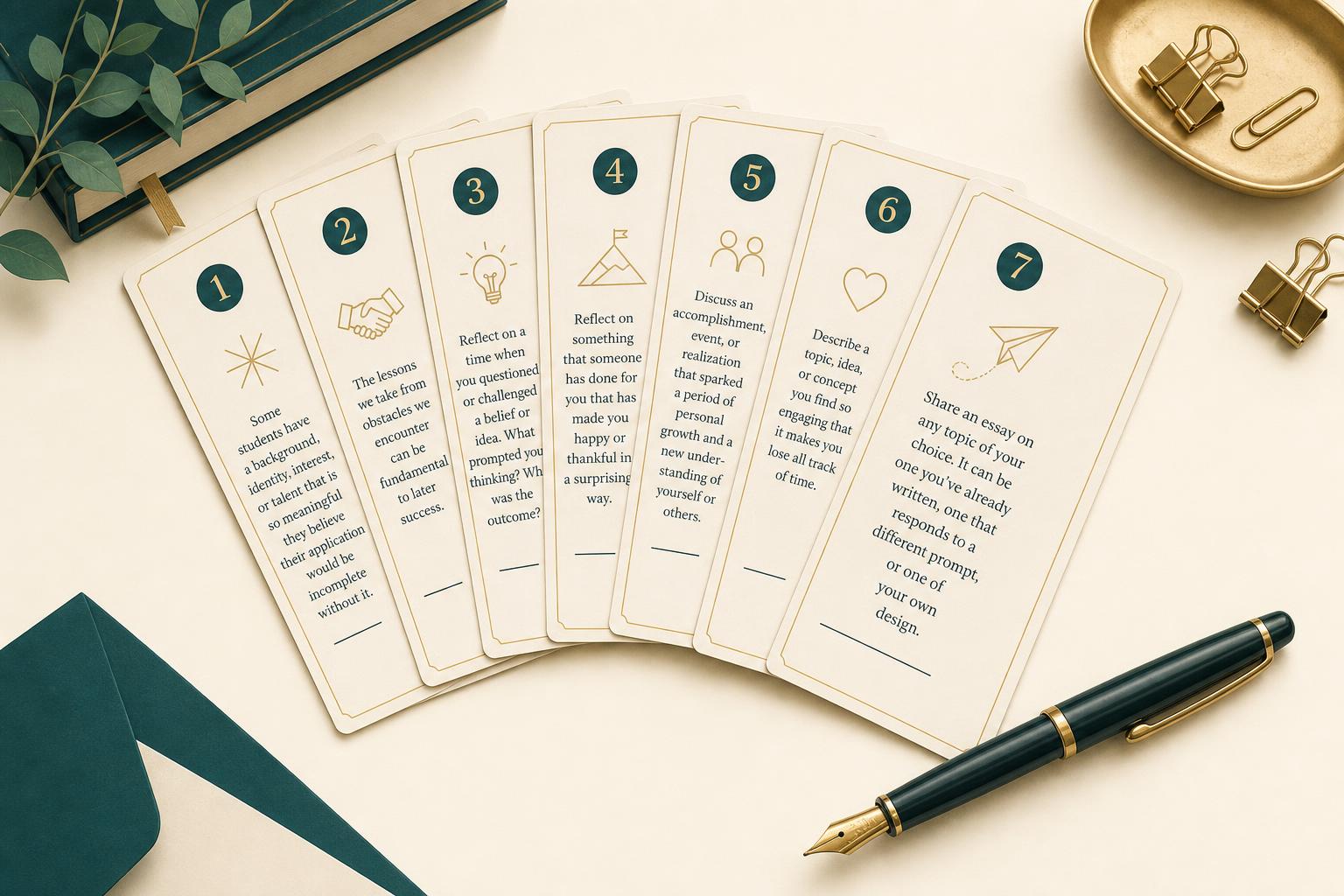
Here are the official prompts for the 2026-27 application year, with a one-sentence translation of what each is really asking and the type of student who tends to write it well.
- Prompt 1: Background, identity, interest, or talent. Translation: who are you when no one is grading you? Strong for students whose family story, cultural background, or lifelong passion is a defining part of how they see the world.
- Prompt 2: A challenge, setback, or failure. Translation: show me how you respond when things go wrong. Strong for students with a concrete moment of difficulty and clear evidence of what changed in their thinking afterward.
- Prompt 3: A time you questioned or challenged a belief. Translation: are you willing to think for yourself, even when it is uncomfortable? Strong for students who can describe a real moment of intellectual honesty, not a polite disagreement.
- Prompt 4: Something that someone has done for you that made you happy or grateful. Translation: what kind of relationships shape you? Strong for students who can write specifically about another person without making the essay about that person instead of themselves.
- Prompt 5: An accomplishment, event, or realization that sparked personal growth. Translation: tell me about a moment you changed. Strong for students with a clear before-and-after, not a victory lap.
- Prompt 6: A topic, idea, or concept you find so engaging that it makes you lose track of time. Translation: what do you think about for fun? Strong for students whose intellectual life is genuinely active outside the classroom.
- Prompt 7: Topic of your choice. Translation: write anything you want, as long as it works. Strong for students who already have a finished essay (often from a teacher's assignment) that answers the unspoken question every admissions reader asks: what do I now know about this person that I did not know before?
How to pick the right prompt for you
Most students pick a prompt first and then try to find a story that fits. Reverse the order. Start with the story, then choose the prompt that lets the story breathe. A simple two-step exercise gets most rising seniors there in an afternoon.
Step one is the brainstorm. On a blank page, list ten moments from the last four years that you still think about. Not the resume bullets. The moments.
The argument with a coach that changed how you practice, the summer job that taught you what tired actually means, the book you finished at 2 a.m. and then re-read the next week, the time you got something wrong in front of a class. Aim for variety in setting (home, school, community) and in feeling (proud, embarrassed, curious, surprised).
Step two is the prompt match. Read your ten moments and notice which prompt each one naturally answers. A story about quitting one sport to commit to another is almost always Prompt 5 (growth) or Prompt 2 (setback).
A story about your grandmother's kitchen is usually Prompt 1 (background) or Prompt 4 (gratitude). A story about an idea you cannot stop thinking about is Prompt 6, full stop. If two prompts fit equally, pick the one that lets you say something an admissions reader has not already read 200 times.
Prompts to be careful with
Not every prompt is equally easy to write. Two come up repeatedly in our reader questions because they are the ones that most often produce a draft the writer is proud of and an admissions reader politely sets aside.
- Prompt 2 (challenge, setback, failure). The risk is writing about a setback that is really a humblebrag (the B+ in AP Chemistry) or a tragedy that you have not had enough time to process on the page. Pick a setback you can describe with specific scenes and a clear shift in how you act now. If the answer to 'what would you do differently' is 'nothing,' choose a different prompt.
- Prompt 7 (topic of your choice). The risk is repurposing a school essay that was strong in the classroom but does not answer the application's underlying question. If you use Prompt 7, the essay still has to show the reader something about you that nothing else in the file shows. A polished analytical essay about The Great Gatsby is rarely it.
The summer drafting calendar that actually works
The students who land in late August with a finished essay almost always followed the same rough cadence. Build it backwards from August 1, when the Common App opens, and you give yourself enough room for the revisions that turn a draft into a personal statement.
- Late June: brainstorm ten moments, pick a prompt, and write a messy first draft of 750-900 words. Over-write on purpose. It is easier to cut than to expand.
- Early July: set the draft aside for at least four days, then re-read it cold. Highlight the two or three sentences that sound most like you. Rewrite around them.
- Mid-July: share the draft with one trusted reader. A parent, a counselor, an English teacher, or an older sibling who knows you well. One reader, not five. Too many voices flatten the essay.
- Late July: revise to fit the 650-word limit. Cut the introduction first. Most strong essays improve when the first paragraph is deleted entirely.
- August 1-7: paste the essay into the Common App's writing section to confirm the word count and formatting, then leave it alone for a week before final proofreading.
- Mid-August: final proof. Read the essay out loud. Anything you stumble over gets rewritten.
What admissions readers are actually looking for
The published advice from selective admissions offices has been remarkably consistent for a decade. The University of Virginia admissions site, the Johns Hopkins essays that worked archive, and MIT's apply hub all say a version of the same thing: be specific, be honest, and let your voice through.
What that looks like on the page is concrete. Specific scenes instead of summaries. Real dialogue (or close to it) instead of paraphrase. A clear sense of what the writer was thinking at the time and what the writer thinks now.
Readers are not looking for the most dramatic life story in the pile. They are looking for an essay that could only have been written by you.
- Specific over general. 'My grandmother's kitchen smelled like cardamom and onions' beats 'I have a close relationship with my grandmother.'
- Reflection over recounting. The events take roughly half the essay. The other half is what you made of them.
- Voice over polish. A sentence that sounds the way you actually talk is worth more than a sentence that sounds like a thesaurus.
- Length matters less than density. A 550-word essay that earns every word beats a 650-word essay that pads to the limit.
How the essay fits the rest of your 2026-27 application
The personal statement is one piece of a much larger file. A rising senior writing the essay in June should already be thinking about how it sits next to the activities list, the supplements, and the financial planning that is happening in parallel. Our senior summer checklist walks through the rest of the summer task list week by week. Families pairing the essay work with early-application strategy should also read Early Decision vs Early Action 2027 and the demonstrated interest 2026 guide, because the early-round deadline often falls just six weeks after the Common App opens.
And if the essay is going to one of the schools on your list, make sure the rest of the file is being built against real data, not brochures. Our school search and side-by-side compare pull verified outcomes from the College Scorecard so you can see graduation rate, net price, and median earnings on every school you are writing toward.
Five short rules to keep on the desk while you write
If you only remember five things from this guide while drafting, make it these. They are the rules that show up in every successful Common App essay we have read in the last three cycles.
- Start with the moment, not the meaning. Open with a scene; let the lesson surface later.
- Write one essay, not three. A single, well-told moment beats a tour of your whole life.
- Cut the first paragraph after the second draft. It is almost always a warm-up.
- Keep the focus on you. If a parent, coach, or friend takes over the page, the essay becomes about them.
- Read the final draft out loud the morning you submit. Your ear catches what your eye misses.
What to do this week
It is the third week of June. The Common App opens in about six weeks. If you do three things this week, you will be ahead of most of your classmates and you will have a real draft to work with in July.
- Read the seven prompts above out loud. Note which two feel most natural without trying to write yet.
- Spend 30 minutes listing ten moments from the last four years. No editing. No ranking. Just the list.
- Pick one moment and write 500 words about it tonight. Bad sentences are fine. A draft is the only thing that turns into an essay.
Further reading
On UniScorecard
- Senior summer college application checklist
Week-by-week summer task list for rising seniors writing essays now.
- Early Decision vs Early Action 2027
How the early-round choice changes which essays are due first.
- Demonstrated interest colleges 2026
Which schools track interest signals alongside the essay.
- How to compare colleges
Building the school list the essay will be sent to.
- School search
Verified outcomes for every Title IV school on your essay's distribution list.
- Side-by-side compare
Put two to four schools next to each other on outcomes and price.
External sources
- Common App essay prompts ↗
The official Common Application page listing the seven 2026-27 first-year essay prompts.
- Common App first-year application requirements ↗
Word count, formatting, and submission rules for the personal statement.
- College Board Big Future apply hub ↗
Plain-language application and essay guidance from the College Board's free college-planning hub.
- Johns Hopkins essays that worked ↗
Annotated archive of admitted-student essays with reader notes.
- MIT admissions apply hub ↗
Direct guidance from MIT's admissions office on the application and writing requirements.
- University of Virginia apply hub ↗
UVA admissions site with application requirements and essay guidance for first-year applicants.
- College Scorecard ↗
Federal outcomes data for every school on your application list.
Related guides
What Is a Good GPA for College Admissions?
Applications open now and your GPA is already set. See what a good GPA for college really means, how weighting works, and how to apply with the grades you have.
College Interview Questions: How to Answer Them
Interview invitations start landing in late August. Get the 30 college interview questions that actually come up, plus what to say and what to ask back.
How Many Colleges Should You Apply To?
Applications just opened. See how many colleges to apply to, what the right reach, target, and likely mix looks like, and what each extra application really costs.
Frequently asked
- What are the 2026-27 Common App essay prompts?
- The Common Application confirmed in February 2026 that the seven essay prompts for the 2026-27 cycle are unchanged from 2025-26. They cover background and identity, a challenge or setback, questioning a belief, gratitude for something someone has done for you, an accomplishment that sparked personal growth, a topic that makes you lose track of time, and a topic of your choice. The 650-word maximum length remains the same.
- When does the Common App open for the 2026-27 cycle?
- The Common Application opens for the 2026-27 first-year application cycle on August 1, 2026. Students can preview the seven essay prompts and begin drafting at any time before that date. The personal statement and most supplements are submitted alongside the rest of the application, with early-application deadlines typically falling on November 1 or November 15 and Regular Decision deadlines in January.
- How long should a Common App essay be in 2026-27?
- The official limit is 650 words and the platform stops accepting characters at that point. There is no minimum word count, but essays shorter than about 500 words rarely give an admissions reader enough material to hear a distinctive voice. Most successful essays land between 550 and 650 words. Density matters more than length: a tightly written 550-word essay is usually stronger than a 650-word essay that pads to the limit.
- Which Common App essay prompt is the easiest?
- There is no easiest prompt. The right prompt is the one that lets you tell a specific story about yourself that the rest of your application does not already tell. That said, Prompt 5 (an accomplishment or realization that sparked personal growth) tends to attract the widest range of strong essays because almost every rising senior has at least one before-and-after moment worth writing about. Prompt 2 (challenge or setback) and Prompt 7 (topic of your choice) are the prompts most often associated with weaker drafts.
- Can I reuse a Common App essay from a teacher's assignment?
- You can use Prompt 7 (topic of your choice) to submit an essay you originally wrote for another purpose, but the piece still has to answer the question every admissions reader is asking: what does this essay show me about you that nothing else in the application shows? A literary analysis, a research summary, or a history paper rarely meets that bar. A reflective personal piece written for an English class sometimes does.
About the author
UniScorecard Editorial
Higher-education data team
We translate the U.S. Department of Education's College Scorecard into plain-language guides for students, families, and counselors. Every metric we publish is sourced directly from the federal Most Recent Cohorts institutional file.
Read our methodology →