Merit Scholarships: How to Win More College Money
Every August a familiar thing happens. Families open the Common App, look at sticker prices near $90,000 a year at private colleges, and assume the only way to bring that number down is to prove they cannot afford it. That is only half the story. Merit scholarships are awarded for grades, test scores, talent, and fit with a college's recruiting goals, and no family income test stands in the way. Most of that money is handed out by the colleges themselves, quietly, during the same admissions read that decides whether a student gets in at all. Which means the decisions that shape your merit aid are the ones you make in the next few weeks, not the ones you make in April.
Higher-education data team
Sources: Figures sourced from the U.S. Department of Education College Scorecard, IPEDS, and Federal Student Aid..

What a merit scholarship actually is
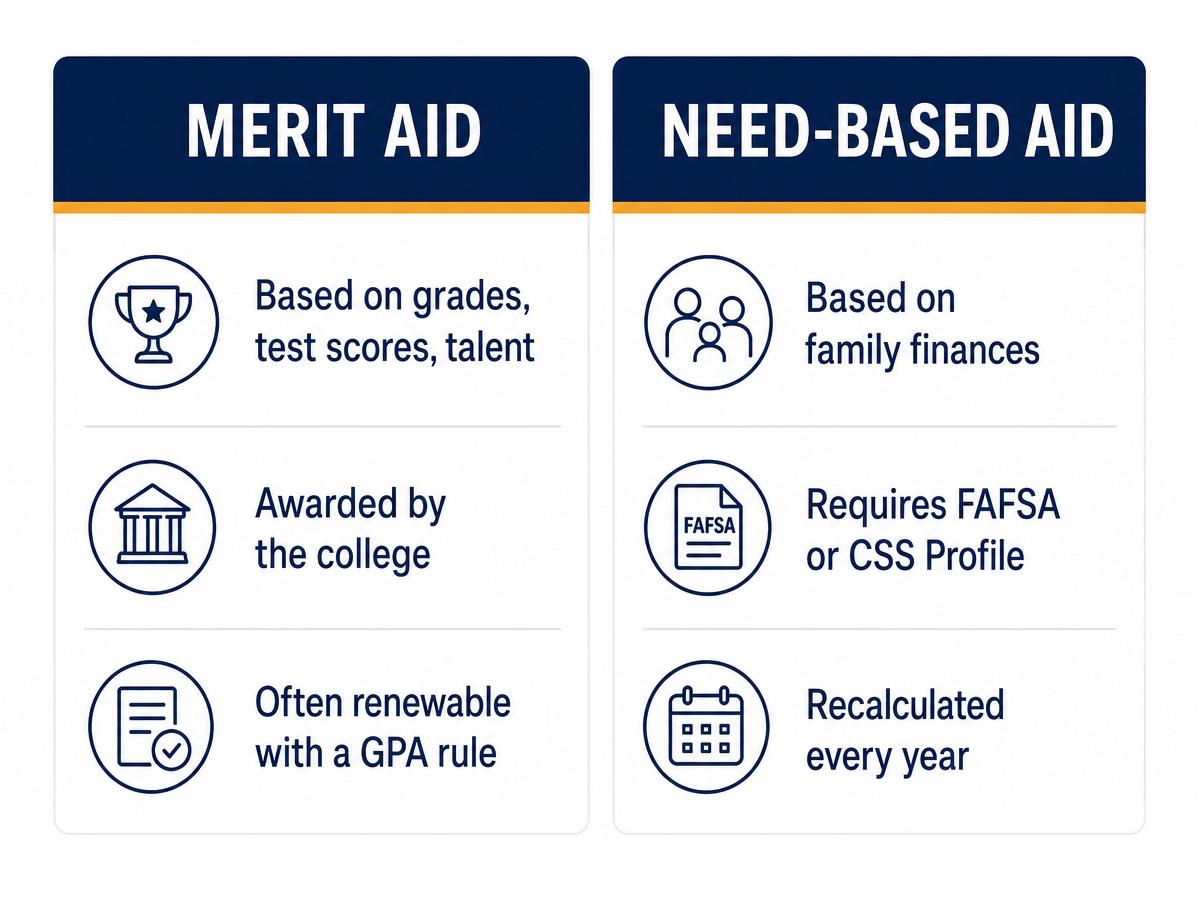
A merit scholarship is money a college or an outside organization gives you because of something you did, not because of what your family earns. Grades, coursework rigor, a test score, a portfolio, a sport, a language, a leadership role, or residency in a particular state can all trigger it.
The practical difference from need-based aid matters. Need-based awards come out of the FAFSA and CSS Profile math and get recalculated every year as your family's finances change. Merit awards are usually locked in at admission and renew as long as you keep a stated GPA, often somewhere between 2.5 and 3.25.
You can hold both at once. A student can receive a $22,000 merit scholarship and a need-based grant on top of it, though some colleges reduce one when the other grows. Ask each financial aid office how the two stack before you commit.
Where the money actually comes from
Students spend hours hunting for outside scholarships worth $500 each and skip the source that writes the biggest checks. Institutional merit aid, awarded directly by colleges, dwarfs private scholarship money for most families.
Four sources are worth your time, roughly in order of payoff:
- College-funded merit awards, applied automatically or through an honors application, frequently in the $5,000 to $30,000 per year range at private colleges and out-of-state publics
- State grant and promise programs tied to residency and a GPA threshold, administered by your state higher-education agency
- National competitive awards such as National Merit, which some universities convert into large or full-tuition packages
- Local and regional scholarships from employers, credit unions, civic clubs, and community foundations, usually $500 to $5,000 but with far smaller applicant pools
Why your college list decides your merit aid
Merit money follows a simple market logic. Colleges use it to attract students who raise their academic profile and to fill seats they need filled. The strongest applicants at a college get the most, and the most selective colleges give the least because they do not need to.
Several Ivy League and comparable institutions award no merit aid at all. Their entire aid budget is need-based. A student with a 1520 SAT gets nothing extra there and might get $30,000 a year at a strong regional university where that score sits in the top decile.
The rule of thumb: you get serious merit aid where your academic record lands well above the college's middle 50 percent. Look up admitted-student test ranges and graduation outcomes for any school on your list on its UniScorecard school page before you decide where to spend your applications.
This is the single most expensive item in the whole process. Two students with identical transcripts can graduate $100,000 apart based only on which twelve colleges they applied to.
How to read a college's merit aid before you apply
You do not have to guess. Three public data points tell you most of what you need to know, and all three are free.
- Average net price by income band, published on the federal net price site, shows what families actually pay after all grants and scholarships
- Percent of students receiving institutional grant aid and the average award, listed for every college on College Navigator
- The college's own scholarship page, which often publishes named award tiers with the exact GPA and test score that triggers each one
The July and August moves that pay off
Timing does most of the work here. Many of the largest institutional scholarships are tied to early application deadlines, and a fair number close before the regular decision date that everyone remembers.
Work through these in order over the next few weeks:
- Pull each target college's scholarship page and write the priority scholarship deadline next to the school on your list, since November 1 and December 1 are common cutoffs
- Flag any college that requires a separate honors college or competitive scholarship application, because those often need an extra essay and a recommendation
- Retake a standardized test in August or September if a published award tier sits just above your current score, since a 30 point move can be worth thousands a year
- Ask your counselor for the school's local scholarship list, which typically opens in the fall and draws far fewer applicants than national databases
- Confirm your state grant program's application, which in several states is the FAFSA itself with a separate state deadline
Outside scholarships: worth it, with limits
Private scholarships are real money, and for a student who needs the last $3,000 to close a gap they can decide the whole thing. Use a free search tool such as BigFuture Scholarship Search and apply to awards where you fit the sponsor's specific criteria rather than the wide-open national contests.
Two cautions. First, never pay a fee to apply or to access a scholarship database, because Federal Student Aid documents the common scam patterns in its scholarship guidance. Second, ask each college how outside awards affect your package, since some reduce their own grant dollar for dollar while others let you reduce loans or work-study first.
A practical target: three to five well-matched local applications beat thirty generic national ones. The odds at a community foundation award with forty applicants are not comparable to a national contest with fifty thousand.
Keeping the money after year one
Renewal terms are where good news turns into a problem three semesters later. Every merit award comes with conditions, and they are stated in the award letter rather than the acceptance letter.
Before you deposit, get written answers on four points:
- The exact renewal GPA and whether it is checked each semester or each year
- Whether the dollar amount is fixed or rises with tuition, because a fixed award shrinks in real terms every year
- The minimum credit load required, often 12 or 15 credits per term
- Whether the scholarship covers a fifth year, which matters at colleges where four-year graduation rates run low
What this looks like in dollars
Consider a student with a 3.8 unweighted GPA and a 1330 SAT. At a highly selective private university where the middle 50 percent starts at 1490, that student is a stretch admit and receives need-based aid only. At a well-regarded regional private university where the middle 50 percent tops out near 1300, that same record often draws a named scholarship in the $20,000 to $28,000 range plus an honors invitation.
Over four years the spread is often larger than the family's entire college savings. That is why the list-building work in July matters more than the essay polish in December.
Compare the actual outcomes of the two schools side by side, since a cheaper degree with a weaker graduation rate is not a bargain. Our college comparison tool puts net price, graduation rate, and median earnings on one screen.
Your next step
Applications open August 1. Between now and then, do one thing: rebuild your college list around merit reality rather than name recognition. Add two or three colleges where your record sits comfortably in the top quarter of admitted students, and check the published award tiers at each one.
Then file the FAFSA when it opens, because a surprising number of institutional merit awards still require it on file. Start with the schools and states you are actually considering on our state guides, and take the numbers from federal data rather than a marketing brochure.
Further reading
On UniScorecard
- Compare colleges side by side
Net price, graduation rate, and earnings on one screen
- Browse every U.S. college
Check where your record lands against admitted students
- State-by-state college guides
Find in-state options with strong merit programs
- How to read a college net price
What families actually pay after aid
- How to pay for college
The full funding stack, in order
- FAFSA 2026-27 deadlines
File on time to protect state and institutional aid
- CSS Profile vs FAFSA
Which form each college requires
- Build a balanced college list
Where merit money is most likely
- How to read a financial aid award letter
Separate grants from loans
External sources
- Federal Student Aid: scholarships ↗
Official guidance, including scam warning signs
- College Navigator ↗
Average institutional grant aid by college
- Net price by income band ↗
U.S. Department of Education price transparency data
- BigFuture Scholarship Search ↗
Free outside scholarship database
- College Scorecard ↗
Federal cost, completion, and earnings data
- NCES Fast Facts: financial aid ↗
National aid receipt statistics
Related guides
How Many Colleges Should You Apply To?
Applications just opened. See how many colleges to apply to, what the right reach, target, and likely mix looks like, and what each extra application really costs.
Out-of-State Tuition: What You Actually Pay
Out-of-state tuition often doubles the sticker price. See what drives the gap, how residency and exchange programs cut it, and how to price your list.
Federal Work-Study: How It Works, What to Accept
Work-study money disappears in August because jobs are first come, first served. See how the award works, what it pays, and how to claim a spot before classes start.
Frequently asked
- What GPA do you need for a merit scholarship?
- There is no single threshold. Many state and college award tiers begin around a 3.0 to 3.5 GPA, while the largest institutional awards usually go to students in the top 10 to 25 percent of a college's admitted class. Check each college's published scholarship tiers, since they list the exact GPA and test score that triggers each award.
- Do you need the FAFSA for a merit scholarship?
- Merit awards are not based on financial need, but plenty of colleges and state programs still require a FAFSA on file before they will disburse the money. File it anyway, because it costs nothing and it also unlocks federal loans and work-study.
- How much merit aid is typical?
- It varies enormously by institution. Private colleges that discount heavily often award $15,000 to $30,000 per year to strong applicants, while the most selective universities award no merit aid at all. College Navigator lists the average institutional grant and the share of students receiving it for every U.S. college.
- Can you negotiate a merit scholarship?
- Sometimes. If a comparable college offered you more, many financial aid offices will review a polite written appeal that includes the competing award letter. Success is far more likely at colleges that are actively competing for your enrollment than at highly selective ones.
- Do outside scholarships reduce your college aid?
- They can. Federal rules require colleges to account for outside awards in your total aid package. Some colleges reduce loans and work-study first, which is good for you, while others reduce their own grant. Ask the financial aid office how they handle it before you accept an offer.
About the author
UniScorecard Editorial
Higher-education data team
We translate the U.S. Department of Education's College Scorecard into plain-language guides for students, families, and counselors. Every metric we publish is sourced directly from the federal Most Recent Cohorts institutional file.
Read our methodology →