College Interview Questions: How to Answer Them
The email usually arrives without much warning. An alumnus in your area has your file, has thirty minutes free next Tuesday, and would like to talk. For most seniors that message lands sometime between late August and early November, which means the interview sneaks up while you are still rewriting the Common App essay. The good news is that college interviews are not tests. Almost none of them are scored, most are read as a light supporting document, and a handful of colleges do not weigh them at all. What they do reveal is whether you can talk about your own choices without a script. That is a skill you can build in an afternoon. This guide covers the questions that actually come up, how to answer the three that trip people up most, what to ask when the interviewer turns it over to you, and how to prepare using real data about the college instead of the brochure.
Higher-education data team
Sources: Interview policies and formats verified against published admissions pages at MIT, Yale, Harvard, and Cornell, plus Common App guidance. Cost and outcome figures come from the U.S. Department of Education College Scorecard..

What a college interview is actually for
Interviews exist mostly to give applicants a human contact point and to give colleges a second read on fit. At the majority of schools the interviewer is a volunteer graduate, not an admissions officer, and the write-up they submit runs a page or less.
That changes how you should prepare. You are not defending a thesis. You are giving someone enough concrete detail that they can write two paragraphs about you that no other applicant could have generated.
Colleges also state their own weighting plainly if you look. MIT treats the conversation as a standard part of the process and explains the setup on its interview page. Yale runs alumni and student conversations and describes availability on its interviews page. Read the page for each school on your list before you assume anything.
- Most interviews are evaluative in a mild way, not decisive
- Most interviewers are alumni volunteers reading from your application, sometimes from nothing at all
- Declining an offered interview is usually neutral, but accepting and skipping it is not
- A few colleges use interviews only for scholarship or honors selection
The 30 questions that actually come up
Interviewers work from a short mental list, and the overlap between schools is large. If you can speak comfortably about six or seven topics, you have covered nearly every version of the conversation.
Group them rather than memorizing them one at a time. There is a personal set, an academic set, an activities set, a school-specific set, and a closing set. Every question you get is a variant of one of those five.
- Tell me about yourself
- Why are you interested in this college?
- What do you want to study, and how did you land on that?
- What is your favorite class this year, and why?
- Which teacher has had the biggest effect on you?
- Tell me about a time you struggled academically
- What do you do outside of class?
- Which activity means the most to you, and why that one?
- Tell me about a leadership role you have held
- Describe a time you disagreed with someone on a team
- What is something you failed at?
- What do you do with a free Saturday?
- What are you reading right now?
- What is a problem in your community you would like to work on?
- How would your friends describe you?
- How would a teacher who does not like you describe you?
- What do you want your roommate to know about you?
- What are you most proud of that is not on your application?
- Where else are you applying?
- What do you hope to get out of college that you are not getting now?
- How do you plan to spend your first summer in college?
- What would you contribute to campus here?
- Which of our programs, professors, or traditions caught your attention?
- What is your intended career direction?
- What is a strength you rely on, and a weakness you are working on?
- Tell me about your family or your hometown
- How do you handle a heavy workload?
- What is something you changed your mind about recently?
- Is there anything on your application you would like to explain?
- What questions do you have for me?
How to answer the three hardest ones
Three questions cause almost all of the freezing. Each one has a shape that works.
The first is the open invitation. Keep it to ninety seconds and give it structure: where you are from, the two or three things you spend the most time on, and what you are aiming at next. Do not recite your resume. Pick one detail with texture in it, because texture is what the interviewer can write down.
The second is the college-specific question, and it fails when the answer could apply to forty schools. Rankings, prestige, and beautiful campuses are not reasons. A specific course sequence, a research center, a co-op requirement, a graduation rate you checked, or a program that matches your intended field are reasons.
The third is the weakness question. Name something real, then describe the mechanism you built to handle it. A student who says they lose track of deadlines and then explains the Sunday planning habit they started in junior year sounds credible. A student who says their weakness is caring too much sounds coached.
- Tell me about yourself: ninety seconds, three anchors, one specific detail
- Why this college: name one academic thing and one practical thing, both verifiable
- Biggest weakness: state it plainly, then show the fix and the result
- Where else are you applying: answer honestly and briefly, then move on
- Any question you cannot answer: say you do not know, then say what you would look up
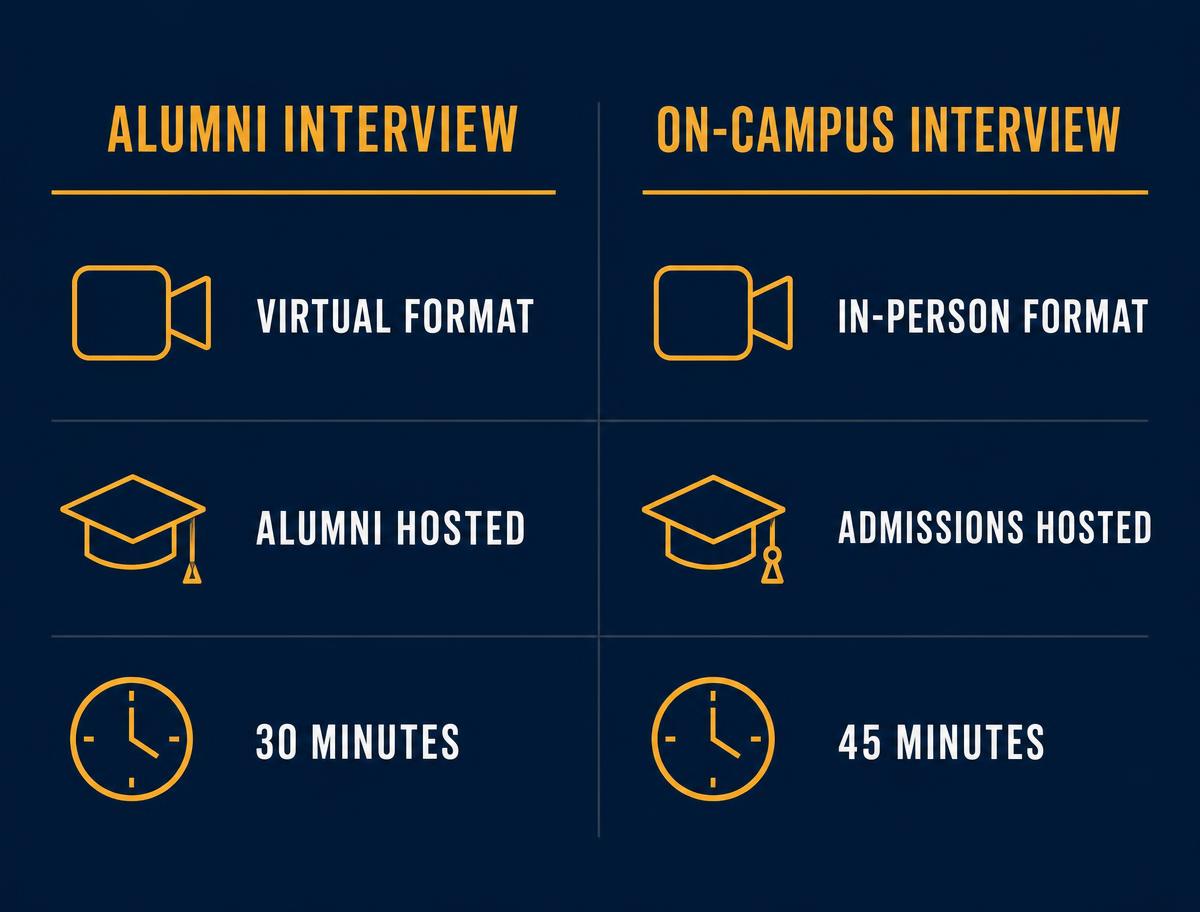
Alumni, on-campus, and recorded formats differ
The format shapes the tone more than the questions do. An alumni conversation over video usually runs twenty-five to forty minutes and feels like a coffee chat. It often happens with an interviewer who has not read your file at all, which means you should assume nothing is known about you.
An on-campus interview with a staff member or trained student runs longer and tends to include a real block of time for your questions. These are worth requesting when the college offers them and you can get there, because in-person conversations produce more detailed write-ups.
Recorded video responses are a third category. A prompt appears, you get short prep time, and you record an answer with no back and forth. Practice out loud before one of these, since the absence of a listener makes most people speed up and flatten out.
- Alumni video: assume the interviewer has not read your application, and introduce yourself fully
- On-campus: expect a longer conversation and bring more questions than you think you need
- Recorded prompts: rehearse aloud on a timer, and answer in complete thoughts
- Group or panel: speak once early so you are not the applicant who never entered the conversation
What to ask the interviewer
Almost every interview ends with the same handoff, and the questions you ask are the part most applicants waste. Anything answered by the first page of the college website makes you look like you did not read it.
Ask about experience instead. An alumnus can tell you what advising felt like, whether it was easy to change majors, how much students actually used the career office, and what they wish they had done differently. Those answers are useful to you regardless of the admissions outcome.
Bring four questions and expect to use two. Write them down beforehand, because the end of an interview is exactly when your memory goes blank.
- What surprised you most in your first year there?
- How easy was it to switch majors or add a second one?
- How did students actually find internships and first jobs?
- What kind of student thrives there, and what kind struggles?
- Which resource do you wish you had used more?
- What has changed about the school since you graduated?
Prepare with data, not the brochure
The strongest interview answers borrow from facts the college publishes about itself. If you can say that you looked at the six-year graduation rate, the net price for your family's income band, and the share of graduates in your intended field, you have already separated yourself from the applicant who says the campus looked nice.
Every school page on this site pulls those figures from federal reporting, so you can check admission rate, net price, completion, and median earnings in a couple of minutes. Start on the college directory and look up each school interviewing you.
Then check where the school sits against its peers. Putting two or three finalists into the comparison tool gives you a sentence like the one interviewers remember: you compared the outcomes and you can say why this one fits the field you are entering.
- Look up admission rate and the admitted test range before you talk
- Check net price for your income band, not the sticker tuition
- Check the six-year graduation rate, since it says more about support than selectivity does
- Find two programs, centers, or requirements that connect to your intended major
- Note one recent change at the school so your interest sounds current
A one-week preparation plan
You do not need a month. You need one focused week, and late August is the right time to run it because early deadlines land on November 1 and interview requests start arriving well before that.
Work in short sessions. Rehearsing for three hours in one sitting produces a script, and a script is the thing interviewers notice fastest.
Keep your written notes to a single page. The point of preparing is to know your material well enough to leave the page behind.
- Day one: write six stories from the past two years, one paragraph each, with a result in every one
- Day two: build your ninety-second self-introduction and say it out loud five times
- Day three: research each interviewing college and write two specific reasons per school
- Day four: write your four questions for the interviewer
- Day five: run a full practice conversation with a parent, teacher, or friend
- Day six: record yourself answering three questions and watch it once at normal speed
- Day seven: fix the two habits you noticed, then stop preparing
The day of, and the day after
Log in ten minutes early for a video call and test the camera and microphone in the actual application you will use. Sit somewhere with a plain background and a door you can close. Have water, a pen, and your one page of notes out of frame.
Dress a step above what you would wear to class. Business casual works everywhere and has never cost anyone an admission. Bring a copy of your activities list in case the interviewer wants to walk through it.
Send a short thank-you email within twenty-four hours. Three sentences is enough: thank them, name one specific thing from the conversation, and confirm your interest. Interviewers submit their write-ups within a few days, so a note that references something real can genuinely sharpen what they remember.
- Test your setup in the same app the interviewer named, not a similar one
- Have your activities list and a page of notes nearby, out of camera view
- Answer in full thoughts, then stop talking and let silence sit for a beat
- Ask your questions even if time feels short, because it signals real interest
- Send a three-sentence thank-you within a day
Do the interview, then get back to the numbers
An interview will rarely make an admission decision for you, and it will almost never break one. What it does is confirm that the person on the page is the person in the room, which is a low bar you clear by knowing your own reasons.
The decision that follows matters far more. Once acceptances arrive in December and March, the schools separate on price and completion, not on how the conversation went in October. Check the FAFSA deadlines now so aid is not the thing that removes a school from your list later.
Before your next interview, spend twenty minutes on the school pages for every college on your list and put your top choices side by side in the comparison tool. Walk in able to say what you found, and the hardest question in the conversation becomes the easiest one to answer.
Further reading
On UniScorecard
- How many colleges should you apply to?
Set the list before interviews start
- How to build a balanced college list
Reach, target, and likely coverage
- The why this college essay
Same research powers your interview answer
- Demonstrated interest at colleges
How interviews fit the wider signal
- Early decision vs early action
When interview requests arrive
- Common App activities list guide
Bring this to the conversation
- Compare colleges side by side
Net price, completion, and earnings together
- Browse every U.S. college
Federal admission, cost, and outcome data
- State-by-state college guides
Check in-state options before you interview
External sources
- MIT interview policy ↗
How one selective school runs interviews
- Yale interviews ↗
Alumni and student conversation formats
- Harvard first-year applicants ↗
Where interviews sit in the process
- Cornell first-year applicants ↗
College-by-college requirements
- Common App first-time students ↗
What the application asks for
- Applying to college overview ↗
Timeline and requirements
- FAFSA deadlines ↗
Federal and state filing dates
- College Scorecard ↗
Federal cost, completion, and earnings data
- College Navigator ↗
Admission rates school by school
Related guides
What Is a Good GPA for College Admissions?
Applications open now and your GPA is already set. See what a good GPA for college really means, how weighting works, and how to apply with the grades you have.
How Many Colleges Should You Apply To?
Applications just opened. See how many colleges to apply to, what the right reach, target, and likely mix looks like, and what each extra application really costs.
Common App Additional Information: What to Write
Learn what belongs in the Common App additional information section, review clear examples, and use our practical September checklist before you submit.
Frequently asked
- What questions are asked in a college interview?
- Nearly every college interview draws from five groups: an opening question about yourself, academic questions about your favorite class and intended major, questions about your activities and leadership, a question about why you want this specific college, and a closing invitation to ask your own questions. The exact wording changes, but the underlying topics rarely do.
- How do I answer tell me about yourself in a college interview?
- Keep it to about ninety seconds and give it structure: where you are from, the two or three things you spend the most time on, and what you want to study next. Include one detail with real texture in it rather than listing your resume, since a specific detail is what the interviewer can write down afterward.
- How long is a college interview?
- Alumni interviews conducted over video usually run twenty-five to forty minutes. On-campus interviews with staff or trained students tend to run longer, often forty-five minutes, and usually leave a real block of time for your questions. Recorded video prompts are much shorter, with a few minutes of total answer time.
- Do college interviews really matter?
- At most colleges the interview is a light supporting document rather than a deciding factor, and the write-up is often a page or less from an alumni volunteer. It matters most as a consistency check between your application and the way you talk about your own choices. Declining an offered interview is usually neutral, but skipping one you agreed to is not.
- What questions should I ask a college interviewer?
- Ask about lived experience rather than facts on the website. Good options include what surprised them in their first year, how easy it was to switch majors, how students actually found internships, and which campus resource they wish they had used more. Prepare four questions and expect to use two.
- What should I wear to a college interview?
- Business casual is the safe answer for every format, including video. A collared shirt, a sweater, or a simple blouse reads as prepared without looking like a job interview for a law firm. For video calls, also check that your background is plain and your camera is at eye level.
About the author
UniScorecard Editorial
Higher-education data team
We translate the U.S. Department of Education's College Scorecard into plain-language guides for students, families, and counselors. Every metric we publish is sourced directly from the federal Most Recent Cohorts institutional file.
Read our methodology →