How to Build a Balanced College List (Class of 2027)
Most students spend the summer writing essays for a college list they never stress-tested. That is the mistake that shows up in April as four rejections and one unaffordable admit. A balanced list of eight to twelve schools, built on real federal admission and cost data before August 1, is the single change that raises the odds of an admit you can actually attend. This guide is the method a Class of 2027 applicant reading this on July 6, 2026 can use this week to lock the list before Common App opens.
Higher-education data team
Sources: Sourced from the U.S. Department of Education's College Scorecard Most Recent Cohorts institutional file, the National Center for Education Statistics IPEDS admissions and enrollment survey, and the NACAC State of College Admission report on application volume and admit-rate trends..

What a balanced list actually means
A balanced list is not a ranking exercise. It is a portfolio of schools split across three admission-odds tiers so that at least one strong offer arrives in the spring and at least one of those offers is affordable. The tiers are Likely, Target, and Reach, and they are defined by how your academic profile compares to a school's admitted class, not by how prestigious the school is on a national list.
The three-tier split most counselors recommend for the Class of 2027 is two Likely, four to six Target, and two to three Reach, for a total of eight to twelve applications. Fewer than eight leaves you exposed. More than twelve dilutes essay quality across the list. The NACAC State of College Admission report confirms that applicants who submit between eight and twelve applications yield the highest rate of at least one affordable admit; volume beyond that raises cost and stress without improving outcomes.
How to sort a school into Likely, Target, or Reach
The tier of a school is set by the gap between your academic profile and the middle 50 percent of the school's admitted class. Pull two numbers on every school on your list: the school's overall admission rate from the federal College Scorecard file, and the middle 50 percent SAT or ACT range from the school's Common Data Set. Then compare against your own unweighted GPA and test score.
- Likely: admission rate above 50 percent, and your test score sits at or above the 75th percentile of the admitted class. You have a strong statistical chance of an admit even in a competitive year.
- Target: admission rate between 20 and 50 percent, and your test score sits inside the middle 50 percent range. This is where four to six of your applications belong.
- Reach: admission rate under 20 percent, or your test score sits at or below the 25th percentile of the admitted class. Every school with a single-digit admission rate is a Reach for every applicant, regardless of profile.
- Wildcard rule: a public flagship out of state with a strong in-state admission preference should sit one tier higher than the raw admission rate suggests. A private with a large Early Decision advantage should sit one tier lower if you are applying Regular Decision.
Balanced versus top-heavy: what the shape looks like
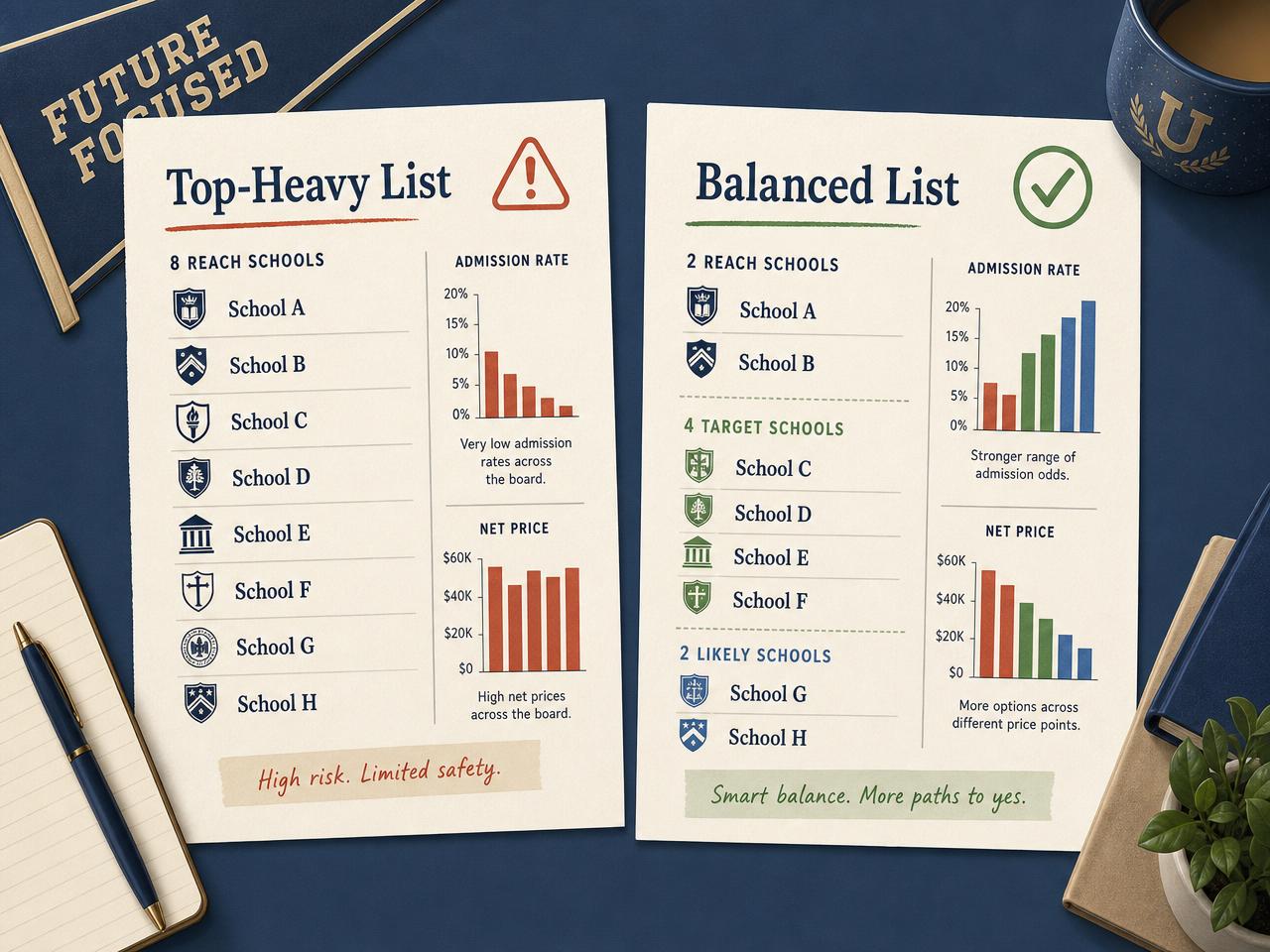
The most common broken list is eight Reach schools with one Target and no Likely. It usually happens when a student builds the list from a national ranking instead of from admission and cost data. The side-by-side below shows what changes when the same student rebuilds the list around federal outcomes.
- Top-heavy list: eight schools with admission rates below 12 percent and sticker prices near $85,000, no realistic financial-aid backstop, and no admit that arrives before March.
- Balanced list: two Reach, four Target, two Likely, with a net-price range from roughly $9,000 to $55,000 across the twelve schools and at least one rolling or Early Action admit that arrives by December.
- Same student, same essays, better outcome shape in April because the list was built for admit spread and cost spread, not brand spread.
Run a fit check on cost before you write the essays
Admission odds are only half of a balanced list. The other half is affordability. A school stays on the list only if the net price, meaning the estimated cost of attendance minus grants and scholarships, works for your family without loans that outrun starting salary. Every school's federal net price by income bracket is published on College Scorecard, and every school is required to post a net price calculator on its own website.
Run the school's own net price calculator for every school on your draft list this week. A twenty-minute calculator run in July prevents a four-month essay investment in a school your family will decline in April. Cross-check the calculator against UniScorecard's side-by-side compare tool to see how three or four finalists stack on net price and median earnings at the same time.
- Pull the school's average net price for your family's income bracket from College Scorecard, not the sticker price.
- Run the school's own net price calculator with your parents' most recent tax figures. Keep a screenshot.
- Compare the calculator result to the average starting salary of graduates on the school's Scorecard profile. A yearly net price above the median first-year salary is a warning flag.
- For any Reach school with a low admit rate and a high net price, confirm the school offers merit aid to admitted students at your profile. If not, keep the school on the list only if your family is comfortable paying full net price.
- For public flagships out of state, use the out-of-state net price, not the in-state figure that shows on the marketing page.
Anchor the list with at least one true Likely you would attend
The Likely school is the anchor of a balanced list. It is not a safety in the outdated sense of a school you would settle for. It is a school with a realistic admit chance where the academic program, the location, and the net price all work. If you would not enroll at your Likely school under any circumstance; it is not a Likely; it is dead weight on the list.
The clearest test is to picture August 2027. If your only admit is your Likely school and you would still commit and move in, the school belongs on the list. If the answer is no, replace it with an in-state public flagship, an honors program at a regional public, or a private with generous merit aid at your profile. UniScorecard's school search filters by state, control, and graduation rate so you can find Likely candidates with strong outcomes near home.
The July 2026 timeline to lock the list before August 1
The Common App opens August 1. Locking the list four weeks earlier gives you a clean runway for supplements, recommendations, and the Free Application for Federal Student Aid (FAFSA) opening in October. The week-by-week plan below fits inside a normal summer without pushing family travel off the calendar.
- Week of July 6: draft a list of fifteen to twenty schools from any source (rankings, family suggestions, campus visits). Do not filter yet.
- Week of July 13: pull admission rate, middle 50 percent test range, and average net price for every school. Sort into Likely, Target, and Reach using the rules earlier in this guide.
- Week of July 20: run the net price calculator on every school. Cut any school where the number does not work for your family and cannot be closed by merit aid at your profile.
- Week of July 27: finalize the list at eight to twelve schools with a two-four-two shape at minimum. Confirm each Likely is a school you would attend.
- August 1: Common App opens. Add all schools to your dashboard on day one so you see the full supplement load before you start writing.
- Pair this timeline with the senior summer college application checklist and the Why This College essay guide so the whole application moves together.
Common list-building mistakes to avoid this month
Most broken lists share the same handful of errors. Fix these five in July and the April outcome shape improves before you write a single essay.
- Building the list from a single national ranking. Rankings measure institutional reputation, not fit or admit odds for you.
- Treating every school under a 20 percent admit rate as a Target because your GPA is high. A single-digit admit rate is a Reach for every applicant.
- Skipping the net price calculator on the theory that financial aid will work out. Aid packages vary by school by tens of thousands of dollars for the same family.
- Adding a school because a friend is applying. Fit is individual; a school that fits your friend may not fit your profile or your budget.
- Leaving the list open past August 1 to keep options alive. An open list means half-written supplements across too many schools. Close the list, then write.
How to use federal outcomes data on every school
Every accredited U.S. college that receives federal financial aid reports the same set of outcomes to the U.S. Department of Education, and the numbers are public on College Scorecard and the National Center for Education Statistics College Navigator tool. Four numbers matter most when balancing a list: admission rate, six-year graduation rate, average net price by income, and median earnings ten years after entry. Pull the four numbers on every school on the draft list and keep them in a single document.
UniScorecard aggregates the same federal file and adds a side-by-side view. Start with How to compare colleges for the framework, How to read a college's net price for the cost tier, and Is a 65 percent graduation rate good for the graduation-rate benchmark.
When to add or drop a school in August or September
The list is not fully frozen on August 1. Two events can move a school on or off in the weeks that follow: a supplement that turns out to be a poor match for your voice, or a financial change that shifts the affordable range. Both are legitimate reasons to swap a school. Neither is a reason to expand past twelve applications. Swap, do not add.
One late-summer add is worth the effort in most years. Look for a public flagship or private with rolling admissions where a strong application submitted in September returns an admit by November. An early admit takes pressure off the Reach applications submitted in December and January and often changes the essays you write in October for the better.
Further reading
On UniScorecard
- How to compare colleges
The four-metric framework to apply to every school on your draft list.
- How to read a college's net price
Net price by income bracket versus sticker price, with worked examples.
- Is a 65 percent graduation rate good
How to benchmark graduation rate for the Likely and Target tiers.
- Senior summer college application checklist
Week-by-week summer plan the list-locking timeline slots into.
- Why This College essay guide
Supplement work is only worth the hours if the school is on a locked list.
- Early Decision vs Early Action 2027
How application timing changes the Reach tier of the list.
- School search
Filter by state, control, and graduation rate to find Likely candidates.
- Side-by-side compare
Stack federal outcomes for up to four finalist schools at once.
External sources
- College Scorecard ↗
Federal admission rate, net price, graduation rate, and earnings data.
- College Navigator ↗
NCES tool for institutional profiles and net price calculators.
- NACAC State of College Admission ↗
National data on application volume and admit trends by tier.
- Common Application ↗
August 1 open date and the member-college supplement list.
- Federal Student Aid ↗
FAFSA open dates and federal aid eligibility rules.
Related guides
Demonstrated Interest 2026: Which Colleges Track It
Which colleges track demonstrated interest for the 2026-27 cycle, the ten signals admissions offices count, and a summer plan to show interest without overdoing it.
Supplemental Essays: A Pre-August Plan for Class of 2027
How Class of 2027 applicants can inventory, schedule, and outline every college supplemental essay before Common App opens on August 1, 2026.
Why This College Essay: How to Write One That Wins
A step-by-step guide to the Why This College supplemental: research, structure, worked examples, and mistakes to avoid before the August 1 open.
Frequently asked
- How many schools should be on a balanced college list?
- Eight to twelve applications is the range that maximizes the chance of at least one affordable admit without diluting essay quality. A common shape is two Likely, four to six Target, and two to three Reach. Fewer than eight leaves you exposed; more than twelve raises cost and stress without improving outcomes.
- What is the difference between a Target and a Reach school?
- A Target school has an admission rate between 20 and 50 percent and your test score sits inside its middle 50 percent range. A Reach school has an admission rate under 20 percent, or your score sits at or below the 25th percentile. Every school with a single-digit admit rate is a Reach for every applicant, regardless of profile.
- Do I need a safety school if my grades and scores are strong?
- Yes. The correct term is Likely, not safety, and every balanced list needs at least one. The Likely school must be a school you would actually attend and enroll at, with a net price that works for your family. Strong grades do not remove the need for a Likely because admit rates at selective schools fluctuate year to year.
- How do I check whether a school is actually affordable?
- Pull the average net price for your family's income bracket from College Scorecard, then run the school's own net price calculator with your parents' most recent tax numbers. Compare the estimated yearly net price to the median starting salary of graduates. A yearly net price above the median first-year salary is a warning flag worth addressing before you apply.
- When should the college list be final?
- Before August 1. The Common App opens August 1 and locking the list four weeks earlier gives you time to run net price calculators, draft supplements, and coordinate letters of recommendation. An open list past August 1 means half-written supplements across too many schools, which lowers quality on every application.
About the author
UniScorecard Editorial
Higher-education data team
We translate the U.S. Department of Education's College Scorecard into plain-language guides for students, families, and counselors. Every metric we publish is sourced directly from the federal Most Recent Cohorts institutional file.
Read our methodology →