Senior Summer Checklist: Class of 2027 College Applications
School ended two weeks ago and the Common Application opens August 1. For the class of 2027, the next ten weeks decide how calm or chaotic the fall will feel. This guide turns the summer into a paced, weekly plan: research the right twelve schools, draft the personal essay once instead of nine times, lock in testing, and have the financial picture clear before the first application opens. Every recommendation here is built around the public 2026-27 admissions calendar from the Common App, Coalition for College, and the major early-decision deadlines.
Higher-education data team
Sources: Sourced from the Common Application, Coalition for College, College Board, ACT, Federal Student Aid, the National Association for College Admission Counseling, and the U.S. Department of Education's College Scorecard..

Why this summer matters more than fall
Senior fall carries five or six classes, a final transcript that colleges read, leadership commitments, and roughly nine applications for the median applicant. Trying to write essays at the same time as taking the November SAT and finishing AP Calculus is the single most common reason strong students send weaker applications than they should.
Summer is also when admissions offices are quietest, which makes it the best window for campus visits, virtual info sessions, and one-on-one calls with financial aid officers. By the time peers start their first drafts in September, students who used the summer well are revising final versions and turning attention back to grades.
The ten-week plan at a glance
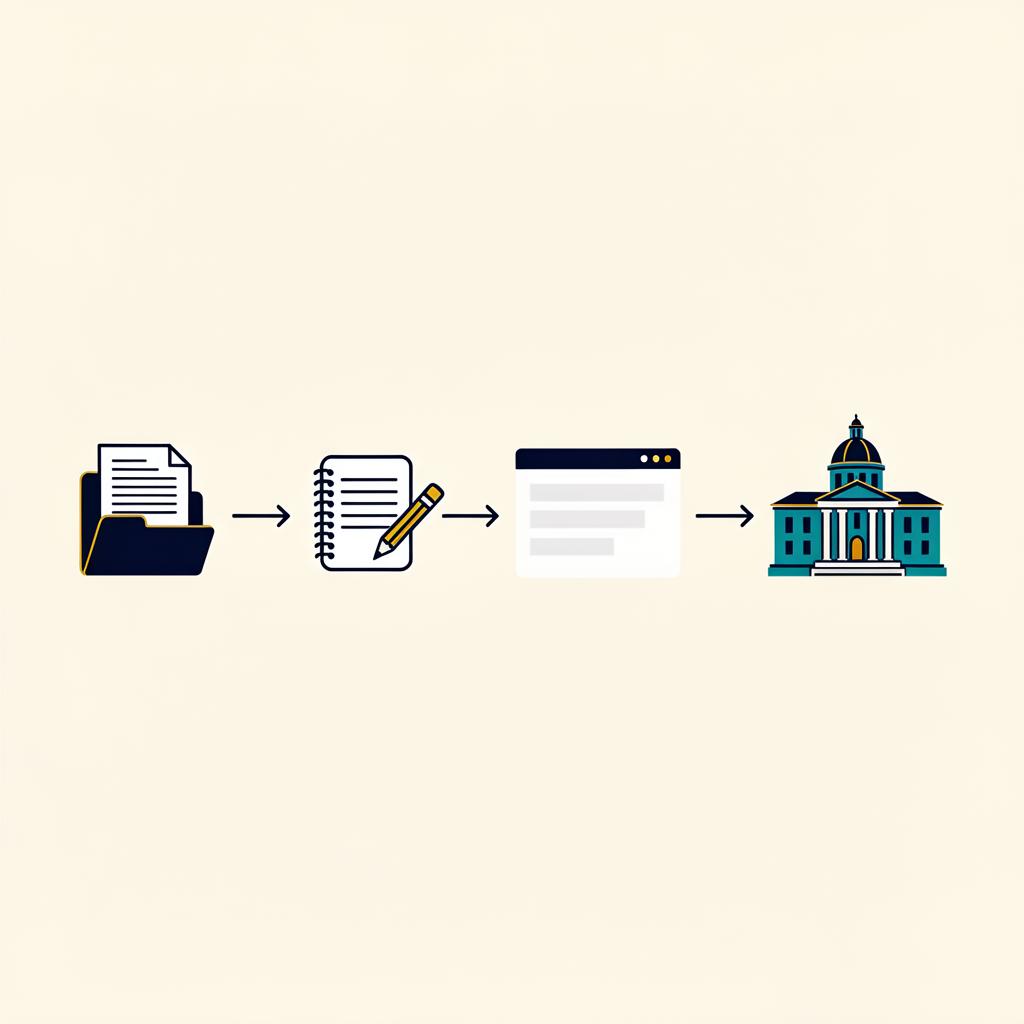
Plan the summer in four blocks. Each one ends with a concrete output that the fall depends on. Treating these as hard deadlines, not aspirations, is what turns a checklist into a finished application.
- Weeks 1 to 2 (early June): build the school list, register for fall testing, and gather transcript and activity records.
- Weeks 3 to 5 (late June through mid July): draft the Common App personal essay and finalize the activities list.
- Weeks 6 to 8 (late July through mid August): open the Common App on August 1, complete supplemental essays for top-choice schools, and submit teacher recommendation requests.
- Weeks 9 to 10 (late August): finalize financial paperwork, polish all essays, and lock in the early-decision or early-action plan before classes resume.
Weeks 1 to 2: build a real school list
The single highest-impact decision of the entire cycle is the school list. The right twelve names cut application costs roughly in half, raise admission yield, and almost always raise net-aid offers because more schools are competing for the same student.
A workable list has three tiers: two to three likely schools where the student's test scores and GPA sit above the 75th percentile, six to seven match schools where they sit between the 25th and 75th percentile, and two to three reach schools below the 25th percentile. The federal College Scorecard and our own school search both publish admission rates, median SAT and ACT, net price, and graduation rates for every Title IV institution in the country.
- Pull each candidate's median SAT, median ACT, admission rate, and net price into one spreadsheet. Use our compare tool to stack up to four schools at a time on outcomes that matter.
- Cross-check graduation rate alongside admission rate. A 35% admission rate with a 58% six-year graduation rate is a different bet than a 45% admission rate with a 78% completion rate.
- Verify the financial fit with each school's official net-price calculator. Sticker price tells you almost nothing; net price after grants is the real comparison.
- Mark every school as test-required, test-optional, or test-blind for the 2026-27 cycle. Policies shifted again this year and the school's official admissions page is the only reliable source.
Weeks 1 to 2: register for fall testing now
Fall test seats fill quickly in August. Register in June and the registration is done; register in late August and the only open seats are often two hours from home. The College Board publishes 2026-27 SAT test dates and registration deadlines on the official SAT calendar, and ACT publishes its national dates on the ACT test dates page.
Students applying through binding early decision in November almost always need a test score from the August or September administration on file. Choose one test date as the target and one as the backup, register for both in the same sitting, and put the dates in the family calendar.
- Pick SAT or ACT. Take one timed full-length practice test of each in the first week of June and pick the higher percentile score. Switching tests after July rarely improves outcomes.
- Budget twelve to fifteen hours of focused practice per week through July. Khan Academy's free Official SAT Practice and the official ACT practice tests cover roughly 80% of what test-prep companies charge for.
- If a student already has a score they are happy with, decide in June whether to retake at all. A 60-point SAT gain is the median improvement for students who put in 40-plus practice hours; under 20 hours, the score usually moves less than the standard error.
Weeks 3 to 5: draft the personal essay once
The Common App essay is 650 words, the same prompt for every school that uses it, and the single piece of writing admissions officers spend the most time on. The 2026-27 prompts were published by the Common Application in February and are unchanged from the prior cycle.
Most strong essays start the same way: a small, specific moment from the student's own life that opens into a larger pattern of how they think. Generic openers about success, hard work, or how the student learned the value of perseverance read as interchangeable to readers who see 40 to 60 essays a day. The goal is for an admissions officer to remember the student a week later from one detail in the first paragraph.
- Spend the first week brainstorming. Write a one-page list of moments, conversations, objects, and decisions that have actually shaped the student. Do not write toward a prompt yet.
- Choose the moment that only that student could have written. If a classmate could plausibly tell the same story with different names, pick something else.
- Draft in week four. Cut the first paragraph after the draft is done. The real opener is almost always the second or third paragraph of a first draft.
- Read the essay out loud in week five. Anything that sounds like a college brochure or a self-help quote is the part to rewrite. Plain, specific writing wins.
Weeks 3 to 5: finalize the activities list
The Common App activities section allows ten entries of up to 150 characters each. The entries do not need to be impressive; they need to be honest, specific, and consistent with the rest of the application. Generic verbs ('participated in', 'helped with') waste characters that a one-line outcome would fill better.
Rank the ten activities in the order the student actually values them, not in the order that sounds most impressive. The first three carry roughly 60% of the section's weight in how readers form an early impression of fit.
Weeks 6 to 8: the Common App opens August 1
The 2026-27 Common Application opens at 12:01 AM on August 1, 2026. Submissions are accepted for early-decision and early-action deadlines through the fall and for regular decision through January or February for most colleges. Most colleges also accept the Coalition for College application; a handful of public university systems (California State and University of California) use their own systems with separate timelines.
Roll the personal essay into the Common App profile on August 1 and start the supplemental essays for the top three to four schools first. Supplements account for the majority of essay work in any application cycle, and almost every selective school assigns at least one school-specific prompt of 100 to 400 words.
- Reuse, do not rewrite. Most selective schools ask a version of 'Why us?' and a version of 'What community do you bring?' A well-built notes document lets a student adapt one strong answer per archetype.
- Request teacher recommendations in early August, not Labor Day. Asking before teachers' fall workloads start is the simplest reason a recommendation arrives on time and reads well.
- Send official transcripts and test scores from the high school and testing agencies in mid-August. Processing takes 7 to 14 days; do not assume same-week delivery.
Weeks 6 to 8: visits, demonstrated interest, and the realistic short list
Visiting two or three schools in person before deadlines hit is one of the few low-cost things that materially changes the application. Admissions readers can tell from the supplemental essay whether a student has been on campus, in a class, or in a conversation with a current student. They do not penalize students who cannot travel, but they reward specific knowledge of the program.
Many private colleges track demonstrated interest. Opening every email, attending the local high school visit, and completing the official virtual tour count. The full list of which schools track interest is maintained in the NACAC State of College Admission report each year.
Weeks 9 to 10: lock in financial aid before classes resume
The 2027-28 FAFSA opens October 1, 2026 for most families, with the on-time December backup release as a contingency. Two pieces of work in late August make the October filing fast: locate the 2025 tax return for both the student and each parent contributor, and create an FSA ID at studentaid.gov/fsa-id for every contributor.
Most selective colleges also require the CSS Profile for institutional aid. The CSS Profile opens October 1 and asks for more detail than the FAFSA, including home equity and small-business assets. Students who plan to apply early decision should plan on submitting both forms by mid-October.
Pair this with our pay-for-college framework and the net-price guide so the family knows what an affordable offer looks like before any letter arrives.
- Locate or request the 2025 federal tax return (1040), W-2s, and 1099s for the student and every parent contributor. The 2027-28 FAFSA uses 2025 tax data.
- Create FSA IDs for the student, each parent contributor, and a spouse if married. Allow at least three business days for Social Security verification.
- Save each school's net-price calculator output in one folder. Award letters in March will reference these numbers and any mismatch is worth a phone call to the school's financial aid office.
Weeks 9 to 10: decide on early decision or early action
Early decision is binding. Applying early decision tells one school the student will enroll if admitted, and it raises admission probability at most selective schools by 1.5 to 2.5 times the regular rate. The trade-off is real: the student loses the ability to compare aid offers, so early decision is only sensible when the school's net-price calculator already returns an affordable number for the family.
Early action is non-binding. It signals interest and often returns a decision in December, freeing the student to focus on AP exams and the regular-decision short list during spring semester. Most students who apply somewhere early choose early action for that reason.
Restrictive early action (used by Harvard, Princeton, Stanford, Yale, Notre Dame, and a few others) sits between the two. It is non-binding but limits where else the student can apply early. The current rules for each school are published on its admissions page and updated each summer.
What to skip this summer
Three things absorb large amounts of time and rarely change outcomes for the median applicant.
- A new last-minute summer program. Admissions readers see roughly the same set of paid programs every year and weight them lightly. A job, a research project, or sustained independent work tells a clearer story.
- An eighth round of SAT or ACT prep when scores have plateaued. The marginal hour after roughly 60 hours of practice rarely moves a score; that hour spent on essays almost always raises the application's quality.
- Applying to twenty schools because one might surprise. Application quality drops sharply past twelve to fourteen. Twelve well-fit applications consistently produce stronger admit and aid outcomes than twenty hurried ones.
Putting the summer together
Start this week with the list. Pull every candidate school into a single spreadsheet, register for the August or September test sitting, and ask the high school counseling office for an unofficial transcript copy before they leave for summer break. Brainstorm essays in late June, draft in mid-July, then open the Common App on August 1 and start the top-choice supplements first.
By Labor Day, a student who used the summer this way has a personal essay in final form, supplements drafted for at least four schools, test scores either banked or scheduled, recommendation requests in motion, and a financial picture clear enough to commit to an early-decision school. Senior fall becomes about finishing strong rather than starting late.
Further reading
On UniScorecard
- How to compare colleges
A data-first checklist for building the right short list.
- How to read a college's net price
Turn any award letter into a comparable cost number.
- How to pay for college
The 2026 funding plan that informs the early-decision call.
- What is a good SAT score?
2026 benchmarks by college type for the testing decision.
- FAFSA 2026-27 deadlines
What rising seniors who deferred this year still need to know.
- Compare schools side-by-side
Stack up to four colleges on admission rate, net price, and outcomes.
- Browse schools by state
State-by-state directory with median net price and graduation rate.
External sources
- Common Application essay prompts ↗
Official 2026-27 personal essay prompts.
- Coalition for College ↗
Alternative application platform used by many selective colleges.
- College Board SAT test dates ↗
Official 2026-27 SAT registration calendar.
- ACT test dates ↗
Official ACT registration and test dates.
- Khan Academy Official SAT Practice ↗
Free, College Board-endorsed full-length SAT practice.
- CSS Profile (College Board) ↗
Institutional financial-aid application required by many private colleges.
- NACAC State of College Admission ↗
Annual report on admissions trends, including demonstrated-interest practices.
- College Scorecard ↗
Federal program-level data on outcomes, debt, and earnings.
Related guides
What Is a Good GPA for College Admissions?
Applications open now and your GPA is already set. See what a good GPA for college really means, how weighting works, and how to apply with the grades you have.
College Interview Questions: How to Answer Them
Interview invitations start landing in late August. Get the 30 college interview questions that actually come up, plus what to say and what to ask back.
How Many Colleges Should You Apply To?
Applications just opened. See how many colleges to apply to, what the right reach, target, and likely mix looks like, and what each extra application really costs.
Frequently asked
- When does the 2026-27 Common Application open?
- The Common Application opens at 12:01 AM Eastern on August 1, 2026 for the 2026-27 admissions cycle. Profile information, the personal essay, and the activities list can be drafted in the prior version's account beforehand and roll over automatically when the new cycle opens.
- How many colleges should a senior apply to?
- Most counselors recommend a balanced list of 10 to 14 schools: two or three likely admits, six or seven match schools, and two or three reach schools. Application quality drops sharply past 14, and so do per-application essay strength and demonstrated interest.
- Do colleges still require SAT or ACT scores for fall 2027 admission?
- Policies vary by school and changed again for the 2026-27 cycle. Several Ivy League schools and large state systems have reinstated testing requirements, while many liberal arts colleges remain test-optional or test-blind. Confirm each school's policy on its official admissions page before deciding to skip testing.
- Is early decision worth giving up the ability to compare aid offers?
- Only when the school's net-price calculator already returns a number the family can pay without negotiation. Early decision is binding, so applying with an affordability question unresolved is the most common reason a student withdraws and forfeits the cycle's strongest position.
- When does the 2027-28 FAFSA open?
- Federal Student Aid has scheduled the 2027-28 FAFSA to open October 1, 2026, with a December backup release as a contingency. The form uses 2025 tax data and asks each parent contributor for a separate FSA ID.
- Can recommendation letters be requested in August?
- Yes, and early August is the best time. Teachers' fall workloads have not started, summer reading lists for next year are already familiar, and the request gives the teacher six to ten weeks to write before the first November early-decision deadline.
About the author
UniScorecard Editorial
Higher-education data team
We translate the U.S. Department of Education's College Scorecard into plain-language guides for students, families, and counselors. Every metric we publish is sourced directly from the federal Most Recent Cohorts institutional file.
Read our methodology →