Subsidized vs Unsubsidized Loans: Which to Accept in 2026
Fall tuition bills land in the next three weeks, and with them comes a portal screen asking students to accept or decline each piece of their aid package. Two lines on that screen look almost identical. One says Direct Subsidized. One says Direct Unsubsidized. Same lender, same interest rate, same monthly payment after graduation. The difference is who pays the interest while you are still in class, and over four years that single word is worth roughly $4,000 to $7,000 to a typical borrower. Nobody explains it at orientation. Here is the whole thing, in the order you need it before you click accept.
Higher-education data team
Sources: Loan terms sourced from Federal Student Aid; cost and outcome figures from the U.S. Department of Education College Scorecard and IPEDS..

The one difference that matters
Both loans come from the U.S. Department of Education. Both carry the same fixed rate for undergraduates in a given year, the same origination fee, and the same repayment options after you leave school.
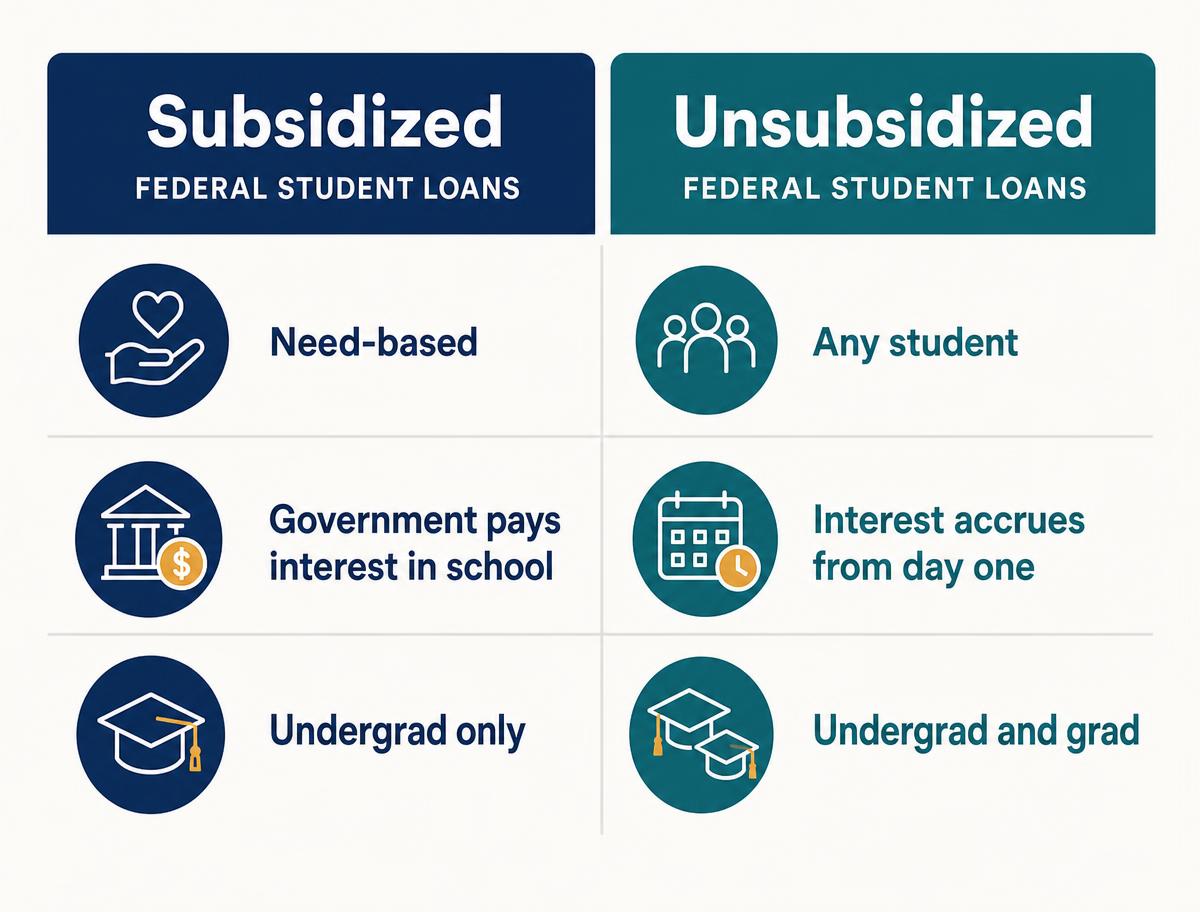
On a subsidized loan, the federal government pays the interest while you are enrolled at least half time, during your six-month grace period, and during approved deferment. Your balance on graduation day is exactly what you borrowed.
On an unsubsidized loan, interest starts the day the money reaches your school and keeps running through every semester, every summer, and the grace period. If you never pay it, it capitalizes, meaning unpaid interest gets added to your principal and then earns interest of its own.
What the gap costs in dollars
Take a student who borrows $5,500 as a freshman at a fixed rate near 6.4 percent and does not pay a cent of interest until after graduation.
If that money is subsidized, the balance at repayment is $5,500. If it is unsubsidized, roughly four and a half years of accrued interest sits on top, pushing the repayment balance close to $7,100 before the first payment is even due.
Stack four years of borrowing and the pattern compounds. A dependent undergraduate who takes the full federal maximum every year graduates owing about $27,000 in principal. On unsubsidized loans left untouched, the repayment balance commonly starts near $33,000 instead. Current rates are published each July on the Federal Student Aid interest rates page.
- Subsidized: no interest accrues while enrolled at least half time, in grace, or in approved deferment
- Unsubsidized: interest accrues every day from disbursement, including summers and the grace period
- Unpaid interest capitalizes at repayment, so you then pay interest on interest
- Both carry the same fixed rate, the same origination fee, and identical repayment plan access
Who qualifies for the subsidized version
Subsidized loans are need-based and undergraduate only. Your college determines eligibility from your FAFSA, using cost of attendance minus your Student Aid Index minus other aid already awarded.
That is why two students at the same college with the same grades get different loan mixes. Nothing about academics enters this calculation, only the aid formula. Federal Student Aid explains the eligibility rules in its subsidized and unsubsidized loan guidance.
There is also a time limit worth knowing. Subsidized eligibility runs out at 150 percent of your program's published length, so six years for a four-year degree. Students who change majors twice or add a fifth year lose access first, right when they still need the money.
How much you can borrow each year
Federal limits are set by year in school and by whether you are dependent or independent. Within each annual cap, only part of the total can be subsidized.
- First year, dependent: $5,500 total, of which up to $3,500 may be subsidized
- Second year, dependent: $6,500 total, of which up to $4,500 may be subsidized
- Third year and beyond, dependent: $7,500 total, of which up to $5,500 may be subsidized
- Lifetime undergraduate cap, dependent: $31,000 total, of which no more than $23,000 may be subsidized
- Independent students and students whose parents are denied a PLUS loan may borrow more, all of the extra amount unsubsidized
The August decision: accept, reduce, or decline
Your award letter lists both loan types with a dollar amount next to each. You are not required to take either, and you can accept a smaller amount than offered. Most portals let you type in a lower figure.
Work through the package in this order:
- Accept every grant and scholarship first, since none of it is repaid
- Accept work-study if it is offered and your schedule allows it, because those earnings do not count against next year's aid formula
- Accept the subsidized loan next, up to what you actually need, since it is the cheapest borrowed money available to undergraduates
- Accept the unsubsidized loan only for the gap that remains after the first three steps
- Treat a parent PLUS loan or a private loan as the last resort, because both carry higher rates and weaker protections
The trick that cuts unsubsidized cost by a third
If you carry unsubsidized loans, you can pay the interest while still in school. There is no penalty for it and no minimum. A student with $12,000 in unsubsidized debt at 6.4 percent accrues roughly $64 a month in interest.
Paying that $64 keeps the principal flat, so nothing capitalizes at graduation. Across four years of gradually increasing balances, students who do this typically start repayment $3,000 to $5,000 lower than students who do not.
A summer job of ten weeks usually covers the entire year of accrued interest. Set up a small automatic payment to your servicer in September and forget about it.
One more habit that pays: check your loan totals every semester on your Federal Student Aid dashboard rather than guessing in your senior year.
Borrow against outcomes, not sticker price
The safest borrowing rule anyone has produced is simple. Keep your total federal debt at graduation below your expected first-year salary in the field you plan to enter.
That rule only works if you know two numbers for each college on your list: what students actually pay after aid, and what graduates actually earn. Both are federal data, and both sit on every UniScorecard school page alongside graduation rate.
Graduation rate belongs in the loan math too. A student who takes five and a half years to finish borrows an extra year of living costs and loses subsidized eligibility on the way. Two colleges with the same net price and a twenty point gap in completion are not the same financial decision.
Put your finalists side by side in our college comparison tool before you accept a single loan dollar.
What changes after you leave school
Repayment starts six months after you drop below half-time enrollment. Both loan types then behave identically, which is the part most families do not expect.
Federal loans carry protections private lenders rarely match: income-driven repayment tied to your earnings, deferment and forbearance during hardship, and eligibility for Public Service Loan Forgiveness. The current menu of plans is listed on the Federal Student Aid repayment plans page.
That protection gap is the reason to exhaust federal borrowing before touching a private loan, even when a private lender advertises a lower headline rate.
Your next step this week
Open your college portal, find the two loan lines, and write down the exact dollar amount of each. Subtract your grants and scholarships from the full cost of attendance and see what gap actually remains. Borrow that number, not the number the portal defaulted to.
If you are a rising senior instead of a starting freshman, you have more room to change the outcome. File the FAFSA the week it opens, because subsidized eligibility depends entirely on that form, and build a list where the cost math works. Start with our state college guides and check every net price against federal data rather than a brochure.
Which loan should you accept first?
Accept grants and scholarships first, then work-study, then the subsidized loan, and finally the unsubsidized loan only for the remaining gap. Subsidized loans are the cheapest federal borrowing because the government pays the interest while you are in school.
- Grants and scholarships: never repay these, so accept the full amount.
- Work-study: accept if your schedule allows; earnings do not count against next year's aid.
- Subsidized loan: accept up to the amount you need before touching unsubsidized loans.
- Unsubsidized loan: use only for the gap that remains after the first three steps.
- Private or parent loans: consider these last because they have fewer protections.
Further reading
On UniScorecard
- How to read a college net price
What families actually pay after aid
- How to pay for college
The full funding stack, in order
- How to read a financial aid award letter
Separate grants from loans on your offer
- FAFSA 2026-27 deadlines
Subsidized eligibility depends on filing
- Merit scholarships
Cut the amount you need to borrow
- Compare colleges side by side
Net price, graduation rate, and earnings on one screen
- Browse every U.S. college
Federal cost and outcome data by school
- State-by-state college guides
Find lower-debt in-state options
External sources
- Subsidized and unsubsidized loans ↗
Official eligibility and limit rules
- Federal student loan interest rates ↗
Current rates and origination fees
- Repayment plans ↗
Income-driven and standard options
- Apply for aid with the FAFSA ↗
Required for subsidized eligibility
- Federal work-study ↗
Earnings that reduce borrowing
- College Navigator ↗
Average aid and loan amounts by college
- College Scorecard ↗
Median debt and earnings by school and field
Related guides
Federal Work-Study: How It Works, What to Accept
Work-study money disappears in August because jobs are first come, first served. See how the award works, what it pays, and how to claim a spot before classes start.
Merit Scholarships: How to Win More College Money
Merit scholarships cut college costs without a financial-need test. Learn who awards them, how much they are worth, and how to target them before applications open.
How to Read a Financial Aid Award Letter (2026 Guide)
Decode your 2026-27 aid award letter in 15 minutes: gift aid vs loans, cost of attendance, comparing offers, and steps before the tuition deposit.
Frequently asked
- Is a subsidized or unsubsidized loan better?
- Subsidized is better whenever you qualify. Both loans carry the same interest rate and repayment terms, but the federal government pays the interest on a subsidized loan while you are enrolled at least half time, in your grace period, or in approved deferment. Accept the full subsidized amount you need before touching unsubsidized money.
- Do I have to accept the full loan amount offered?
- No. You can accept part of an offered loan or decline it entirely, and most college portals let you enter a lower amount. Borrow only the gap that remains after grants, scholarships, savings, and work-study.
- How much interest builds on an unsubsidized loan in college?
- At a rate near 6.4 percent, a $5,500 unsubsidized loan accrues roughly $350 a year. Left unpaid through four years of school plus the six-month grace period, that single loan enters repayment about $1,600 higher than the amount borrowed.
- Can I pay interest on an unsubsidized loan while in school?
- Yes, and it is the cheapest move available to you. Voluntary interest payments have no penalty and no minimum. Paying interest as it accrues stops it from capitalizing into your principal at repayment.
- How much can a first-year student borrow in federal loans?
- A dependent first-year undergraduate can borrow $5,500 in Direct loans, of which up to $3,500 may be subsidized. Limits rise to $6,500 in year two and $7,500 in later years, with a $31,000 lifetime cap for dependent undergraduates.
About the author
UniScorecard Editorial
Higher-education data team
We translate the U.S. Department of Education's College Scorecard into plain-language guides for students, families, and counselors. Every metric we publish is sourced directly from the federal Most Recent Cohorts institutional file.
Read our methodology →