How Many Colleges Should You Apply To?
The Common App opened on August 1, and the first real decision of senior year is not which essay to write. It is how many colleges to apply to. Get the number wrong on the low side and you can finish April with one option you cannot afford. Get it wrong on the high side and you spend the fall writing thirty supplemental essays that all read like the fourth draft of the same paragraph. Most students land in the right place with eight to ten applications, split across schools where admission is a long shot, schools where the odds are even, and schools that would almost certainly take them. What makes that number work is not the count. It is whether every school on the list is one you would attend and one your family can pay for. This guide walks through how to set your number in August, what each additional application actually costs in money and hours, and where students consistently pad their lists with schools that do them no good.
Higher-education data team
Sources: Application counts, admission rates, and cost figures sourced from the U.S. Department of Education College Scorecard, NCES, and published Common App and College Board policy pages..

The short answer: eight to ten, built in three tiers
For most students, eight to ten applications covers the range of outcomes without wrecking the quality of the writing. Below six, a single bad admissions cycle can leave you with no affordable choice. Above twelve, the essays start to thin out and the fee total climbs past what the extra safety is worth.
The count matters less than the split. A list of ten where nine are highly selective is not a list of ten. It is one likely school with nine lottery tickets attached.
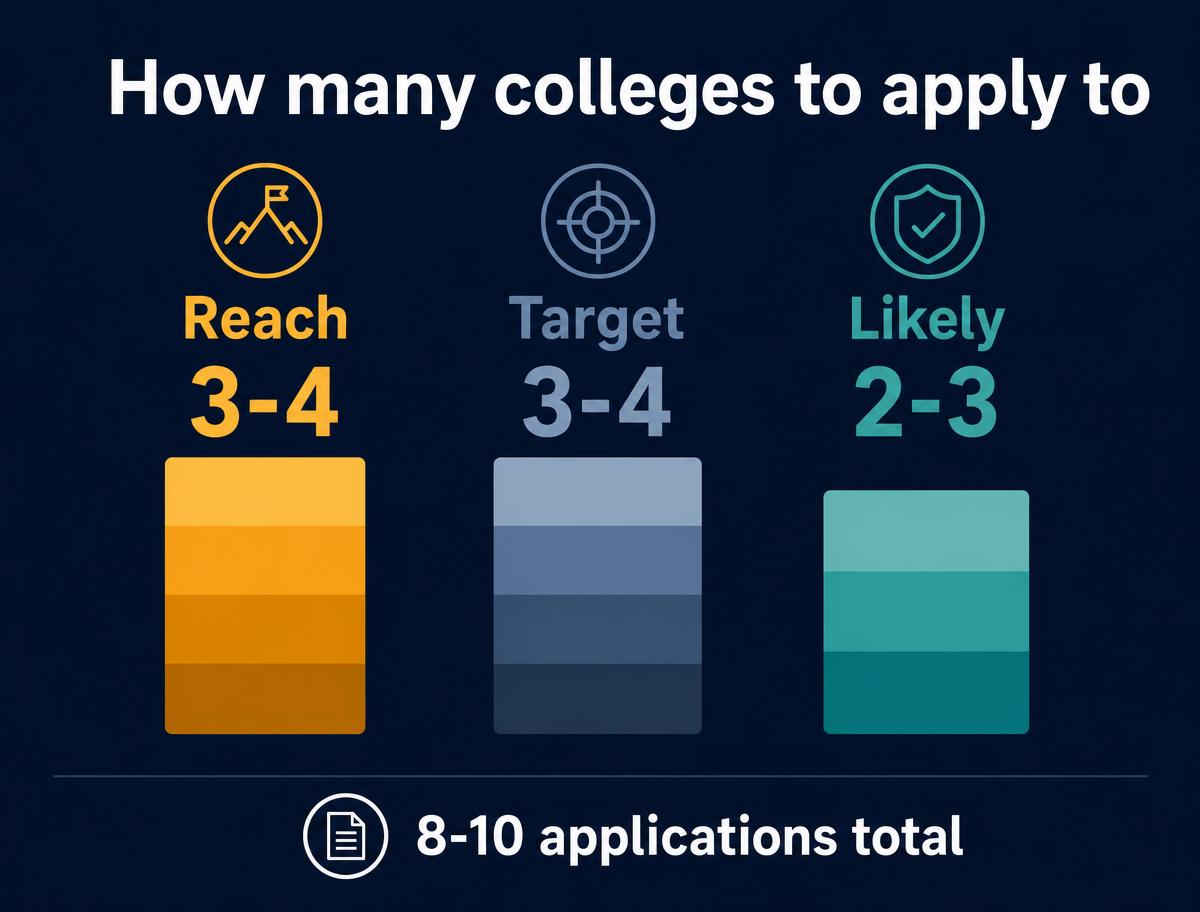
Work backward from the tiers instead of the total. Three or four reach schools, three or four targets, and two or three likely schools gives you a list that holds up whether the cycle goes well or badly.
- Reach: your academic profile sits below the school's admitted range, or the admission rate is under about 25 percent
- Target: your grades and test scores sit inside the middle range of admitted students
- Likely: your profile sits above the admitted range and the admission rate is comfortably high
- Every tier needs at least one school your family can fund without heavy borrowing
Why more applications stopped raising your odds
Applying to more schools does raise the chance of one acceptance, but the gain flattens fast. Adding a fourth target school moves the odds meaningfully. Adding a fifth reach school with a 6 percent admission rate barely moves them at all, because low-probability outcomes stacked on each other stay low.
There is a cost on the other side of that trade. Selective colleges read for fit, and fit shows up in the supplemental essays. A student with eight carefully written applications almost always presents better than the same student with sixteen recycled ones.
The volume trend is real, though. Common App reports that the average applicant now submits to more colleges than a decade ago, and the busiest applicants file more than twenty. The acceptance rates at the most selective schools did not improve as a result. They fell, because the applicant pools grew.
- Two extra reach schools add very little probability and a lot of writing
- One extra well-matched target school adds real probability
- One extra affordable likely school adds the most protection per hour spent
- Every application you would not attend if admitted is pure cost
What each application actually costs
Application fees usually run $50 to $90 each, and a twelve-school list can pass $800 once score reports and transcript fees are added. That money is spent whether or not you get in.
Fee waivers change the math completely. If you qualified for an SAT fee waiver, received free or reduced-price lunch, or your family income falls under the published thresholds, you can apply free through the Common App fee waiver, which colleges are required to honor. The rules sit on the Common App fee waiver page and the College Board fee waiver FAQ.
The larger cost is time. A realistic supplemental essay set for one selective school runs three to six hours including revision. Twelve of those is a part-time job stacked on top of a senior fall.
- Budget $50 to $90 per application fee, plus score and transcript sending fees
- Check the waiver thresholds before you pay anything, since they cover more families than most people assume
- Count three to six hours of writing per school with supplements
- Note which colleges have no supplemental essay, because those cost almost nothing to add
- Note which colleges have no application fee at all, since a growing number waive it during specific fall weeks
Set your number from your data, not a rule of thumb
The right count depends on how predictable your list is. A student applying mostly to public universities with published admission ranges needs fewer applications than a student aiming at highly selective private colleges where decisions are harder to model.
Look up the admission rate and the admitted test range for every school you are considering before you decide how many to add. Both figures come from federal reporting and sit on each school page here, next to net price and graduation rate.
Then check the aid picture. A list of ten schools that all require heavy borrowing is riskier than a list of seven with two affordable options, no matter what the acceptance odds look like.
- Six to eight applications is often enough if most of your list is public and predictable
- Ten to twelve makes sense if most of your list is highly selective private colleges
- Add one more likely school if your family needs a specific price to work
- Add one more target if your test scores are missing and the schools are test-optional
Where lists go wrong
The most common failure is not too few schools. It is a list where the likely schools were chosen for convenience rather than genuine interest, so the student refuses to attend one in April and ends up with no real choice.
The second failure is a list that ignores money until the offers arrive. A school is only a likely option if the admission odds are high and the price works. An affordable-looking public college with a low graduation rate can cost more in the end than a pricier one that finishes students in four years.
The third is duplication. Six schools with the same size, same region, and same academic profile do not diversify a list. They repeat the same bet.
- Delete any school you would not attend if it were your only acceptance
- Replace it with one you would attend and can afford
- Check that your list spans more than one price structure, including at least one in-state public option
- Verify each likely school on graduation rate, not just on admission odds
- Keep your list to schools that offer your intended field of study
How early decision and early action change the count
Applying early does not reduce the number of applications you prepare. It reorders them. Early deadlines usually fall on November 1 or November 15, which means the writing has to be done in September and October instead of December.
Early decision is binding, so you file one and you attend if admitted and the aid works. Early action is not binding, and filing three or four early action applications can give you acceptances in December that make the rest of the list easier to trim.
That is the practical argument for early action. If two of your likely schools admit you in December, you can drop the two weakest schools from your regular decision list and put those hours into the applications that matter. Our guide to early decision versus early action covers the trade-offs in detail.
- Prepare the full list in August and September, then assign deadlines
- File early action at likely and target schools to lock in December acceptances
- Use only one early decision slot, and only if the school is a clear first choice
- Revisit the regular decision list in December once early results arrive
A three-week plan to lock your list
August is the month this gets settled, because supplemental essay prompts are live and deadlines are still eleven weeks out. Work in short passes rather than trying to finalize everything in one sitting.
Start wide and cut. A list of twenty candidates trimmed to nine with reasons written down beats a list of nine assembled from memory and social pressure.
The Common App first-time student guide walks through account setup, and the BigFuture application overview covers what each college requires.
- Week one: list every school you are considering, then record admission rate, net price, and graduation rate for each
- Week one: mark each school reach, target, or likely using the admitted ranges
- Week two: cut every school you would not attend, then fill the gaps so each tier has coverage
- Week two: confirm fee waiver eligibility and count total application fees
- Week three: assign each school an early or regular deadline and count the supplemental essays
- Week three: if the essay count exceeds what you can write well, remove the weakest reach school first
Price the list before you write a word of it
The number that decides where you enroll is net price, not tuition. Federal data shows what students in your income band actually paid at each college after grants and scholarships, which is the only figure worth comparing across schools.
Run every school on your short list through that check now. Filing the FAFSA in October keeps you eligible everywhere, and the federal deadline page lists the state deadlines that come earlier.
Put your finalists side by side in the college comparison tool and look at net price, graduation rate, and median earnings together. If a school does not hold up on all three; it is not earning one of your eight to ten slots. Settle that in August and the fall becomes a writing project instead of a guessing game.
Further reading
On UniScorecard
- How to build a balanced college list
Choosing which schools fill each tier
- Early decision vs early action
How deadlines change your list order
- College application fee waivers
Apply free if you qualify
- How to read a college net price
The price that decides where you enroll
- Is a 65 percent graduation rate good?
Vetting your likely schools
- Common App essay prompts
The writing behind each application
- Compare colleges side by side
Net price, completion, and earnings on one screen
- Browse every U.S. college
Federal admission, cost, and outcome data
- State-by-state college guides
Find affordable in-state options
External sources
- Common App first-time students ↗
Account setup and what to expect
- Common App fee waiver rules ↗
Who qualifies to apply free
- College Board fee waiver FAQ ↗
Thresholds and documentation
- Applying to college overview ↗
What each college requires
- FAFSA deadlines ↗
Federal and state filing dates
- College Scorecard ↗
Federal cost, completion, and earnings data
- Net price resources ↗
What students actually pay after aid
- College Navigator ↗
Admission rates school by school
Related guides
What Is a Good GPA for College Admissions?
Applications open now and your GPA is already set. See what a good GPA for college really means, how weighting works, and how to apply with the grades you have.
College Interview Questions: How to Answer Them
Interview invitations start landing in late August. Get the 30 college interview questions that actually come up, plus what to say and what to ask back.
Common App Additional Information: What to Write
Learn what belongs in the Common App additional information section, review clear examples, and use our practical September checklist before you submit.
Frequently asked
- How many colleges should I apply to?
- Eight to ten applications works for most students, split into three or four reach schools, three or four targets, and two or three likely schools. Fewer than six leaves you exposed if a cycle goes badly, and more than twelve usually means weaker essays. The split matters more than the total, and every tier needs at least one school your family can afford.
- Is 20 college applications too many?
- For almost everyone, yes. Beyond about twelve, extra applications add very little probability while the supplemental essays get noticeably worse. The exception is a student applying almost entirely to schools with single-digit admission rates who has fee waivers and a genuine reason to attend each one.
- How much does it cost to apply to 10 colleges?
- Application fees generally run $50 to $90 per school, so ten applications cost roughly $500 to $900 once score and transcript sending fees are included. Fee waivers eliminate that cost entirely for students who qualified for an SAT fee waiver, received free or reduced-price lunch, or fall under the published income thresholds.
- How many safety schools do I need?
- Two or three, and each one has to be a school you would genuinely attend at a price your family can pay. A likely school you would refuse in April is not protection. Check its graduation rate as well as its admission rate, since a low completion rate can cost more than a higher sticker price.
- Do more applications improve my chances of getting in?
- Only up to a point, and mostly at target and likely schools. Adding a fourth well-matched target school raises your odds meaningfully. Adding a fifth reach school with a 6 percent admission rate barely changes them, and the time it takes usually lowers the quality of the applications you already had.
- Should I apply early to reduce the number of applications?
- Early action can help. Non-binding early applications at likely and target schools often produce December acceptances, which lets you drop the weakest schools from your regular decision list. Early decision is binding, so use at most one and only for a clear first choice where the aid offer works.
About the author
UniScorecard Editorial
Higher-education data team
We translate the U.S. Department of Education's College Scorecard into plain-language guides for students, families, and counselors. Every metric we publish is sourced directly from the federal Most Recent Cohorts institutional file.
Read our methodology →