Out-of-State Tuition: What You Actually Pay
Rising seniors start building their college lists in August, and almost every list has one school on it that sits three states away and costs twice what the flagship at home charges. That second number is out-of-state tuition, and it is the single largest swing in the price of an undergraduate degree. Public colleges charge residents a discounted rate because state taxpayers already covered part of the bill. Everyone else pays the unsubsidized rate, which at many flagships runs $25,000 to $45,000 a year before housing. The gap is not fixed, though. Residency rules, regional exchange agreements, and merit aid can shrink it to almost nothing at some schools and leave it untouched at others. This guide shows you where the money goes, which discounts are real, and how to price every school on your list before applications open.
Higher-education data team
Sources: Tuition, residency, and net price figures sourced from the U.S. Department of Education College Scorecard, IPEDS, and NCES; exchange program terms sourced from the regional compacts that administer them..

Why two students in the same lecture pay different prices
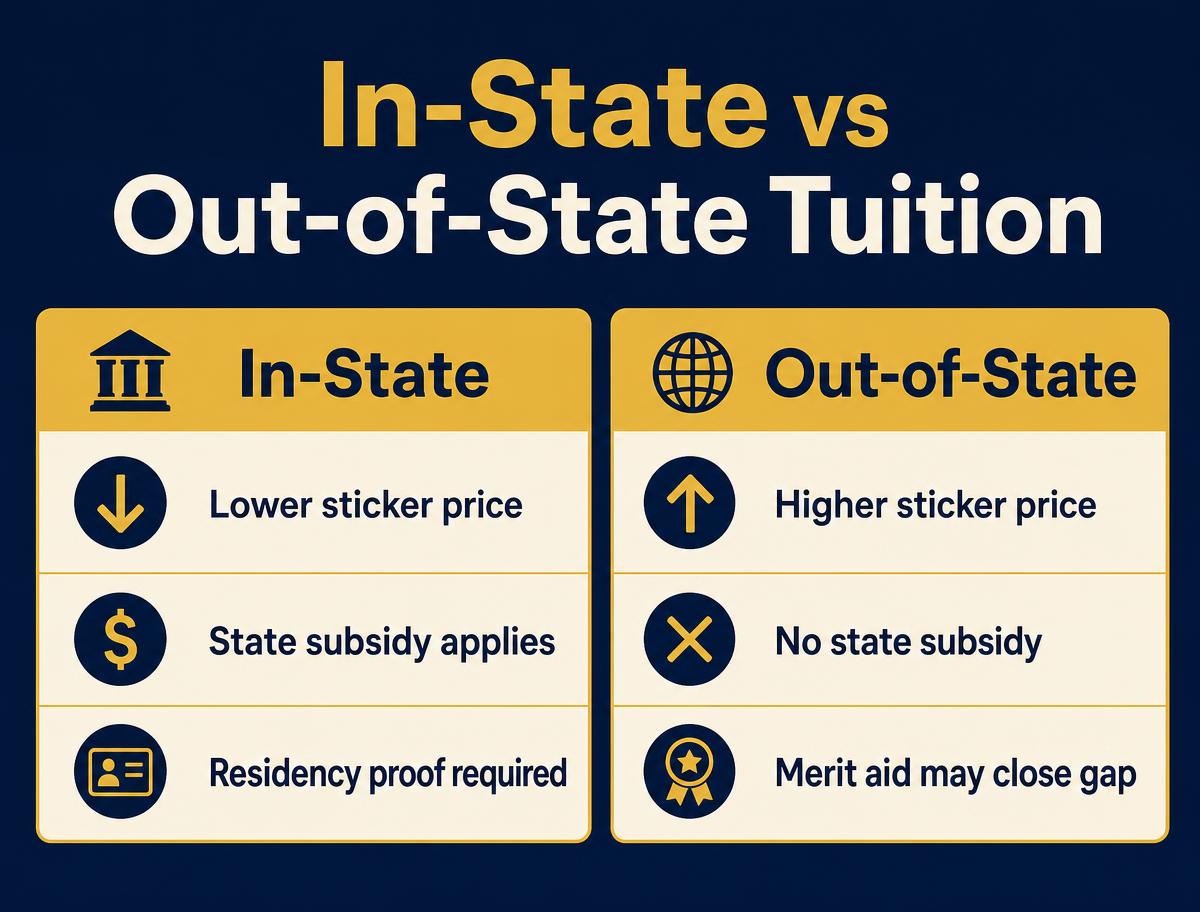
A public university has three income streams for undergraduate teaching: state appropriations, tuition, and everything else. State money arrives with a condition attached. It is meant for residents of that state, so the tuition rate for residents is set after the subsidy is applied.
Out-of-state students receive no share of that appropriation. Their tuition line has to cover the full instructional cost, which is why it frequently lands at two to three times the resident rate at the same institution.
That structure explains the pattern you see in federal data. Across public four-year colleges, average published in-state tuition and fees sit near $10,000 a year while the out-of-state figure sits near $28,000, according to the National Center for Education Statistics tuition tables. Private colleges charge one rate to everyone because no state subsidy is involved.
The gap is wider than students expect, and uneven
Families tend to assume the out-of-state penalty is roughly the same everywhere. It is not. Some flagships charge non-residents about $12,000 more; others charge more than $35,000 more for the identical degree.
The pattern tracks state politics and enrollment strategy. States with declining numbers of high school graduates court non-residents with a smaller premium and generous merit awards. States with strong resident demand have no reason to discount, so the premium stays steep.
Two schools with nearly identical academic profiles can therefore differ by $80,000 over four years for the same out-of-state student. That is why the comparison has to happen school by school rather than state by state.
- Look up both tuition figures for every public college on your list, not just the one you saw first
- Multiply the annual gap by four, then add expected annual increases of two to four percent
- Check whether the college posts a separate non-resident fee on top of tuition
- Note whether housing and meal rates differ for non-residents, which they occasionally do
Regional exchange programs are the biggest legal discount
Groups of states run reciprocity compacts that let students attend a member college in another state at a reduced non-resident rate. These are formal programs with published participating majors and campuses, not case-by-case favors.
The Western Undergraduate Exchange, run by the Western Interstate Commission for Higher Education, caps tuition at 150 percent of the resident rate at participating campuses across the West. Details and the campus list sit on the WUE program page.
In the South, the Southern Regional Education Board runs the Academic Common Market, which grants in-state tuition to students pursuing a degree program their home state does not offer. New England has its own version through the New England Board of Higher Education Tuition Break program.
- Confirm your home state is a member of the compact you plan to use
- Check that your intended major is on the approved list for that specific campus, since eligibility is program-level
- Apply for the rate through the college's stated process, which usually has its own deadline
- Ask whether the discounted rate renews automatically or requires yearly certification
- Ask what grade point average keeps the rate in place after freshman year
How residency actually gets established
Every public system publishes a residency policy, and the standards are stricter than most families guess. Renting an apartment near campus does not create residency. Neither does registering a car or opening a local bank account by itself.
Most states require twelve consecutive months of physical presence before the term begins, plus evidence that the move was for reasons other than education. Financial independence from out-of-state parents is a common additional requirement, and a dependent student claimed on a parent's tax return in another state rarely clears it.
There are real exceptions worth checking. Active-duty military families, veterans using federal education benefits, and employees of the university itself often qualify for the resident rate immediately under state law.
- Read the residency policy on the specific system website, not a third-party summary
- Count the required months backward from the first day of the term you want covered
- Gather proof: lease, employment records, state tax filing, voter registration, driver license
- Verify whether accepting non-resident scholarship money blocks a later reclassification, because at some schools it does
- File the reclassification petition before the published deadline, which usually falls weeks before classes start
Merit aid is what closes the gap in practice
Most students who pay less than the posted non-resident rate get there through institutional merit money rather than reclassification. Public universities use scholarships to recruit out-of-state students with strong academic records, and the awards are often automatic based on grade point average and test scores.
The math can flip a decision. A $22,000 non-resident premium met with a $20,000 renewable award makes that college competitive with the flagship at home. The same award at a school with a $35,000 premium still leaves a serious bill.
Automatic awards are published, which means you can calculate your price before you apply. Our guide to merit scholarships walks through where the published grids live and how renewal conditions work.
- Search the college's site for an automatic or assured scholarship chart
- Confirm whether the award is renewable for four years and what grade point average sustains it
- Ask whether the award stacks with a regional exchange rate or replaces it
- Apply by the priority scholarship deadline, which is frequently in November or early December
Price the school, not the sticker
Tuition is one line on a bill that also includes fees, housing, food, books, and travel. Net price captures the whole thing after grant and scholarship aid, and it is the only figure worth comparing across schools.
Federal net price data comes from what students at that college actually paid, broken out by family income band. The U.S. Department of Education publishes it through the net price resources on its college cost site, and the College Scorecard carries the same figures alongside graduation rates and median earnings.
For an out-of-state school, add one cost families forget: getting there. Two round trips a year plus winter break travel can add $1,200 to $2,500 annually, and that money does not appear anywhere in the published cost of attendance for many colleges.
- Start with net price for your income band, not published tuition
- Add travel: flights or fuel for at least three round trips a year
- Add the cost of storing or shipping belongings over summer break
- Add health insurance if your family plan has a limited regional network
- Compare the four-year total, since annual increases compound on the larger base
When paying out-of-state tuition is the right call
Sometimes the premium buys something real. A specific program the home state does not offer, a clinical placement network, or a licensure pathway tied to a particular region can justify the cost.
Graduation rate is the other side of the ledger. Finishing in four years at a more expensive college often costs less than six years at a cheaper one, because two extra years mean two more years of tuition and two fewer years of earnings.
Ask what the money is buying, then check whether the outcome data supports the claim. Median earnings by field of study and completion rates for each school sit on every UniScorecard school page, pulled straight from federal reporting.
Build the list with prices attached
Applications open in the next few weeks, and the cheapest time to catch a cost problem is before you write a supplemental essay for a school your family cannot fund.
Work through your list once with two columns: the price you would pay as a non-resident and the price after any published automatic award. Then set the same figures against your in-state options using our state college guides, which group public colleges by state with median cost and graduation figures.
Put your three or four finalists side by side in the college comparison tool. If the out-of-state school still holds up on net price and completion after that, it has earned a spot. If it does not, you found out in August instead of April.
- List every public college on your list with both tuition rates recorded
- Note which ones are reachable through a regional exchange program
- Record the automatic scholarship you would qualify for at each
- Flag any school whose four-year total exceeds what your family can fund without heavy borrowing
- Keep at least two in-state options that you would genuinely attend
Further reading
On UniScorecard
- How to read a college net price
The figure that replaces sticker price
- How to build a balanced college list
Where cost fits in list building
- Merit scholarships
How non-residents close the tuition gap
- How to pay for college
The full funding stack, in order
- Community college vs university
A lower-cost route to the same degree
- How to read a financial aid award letter
Check the offer against the real bill
- State-by-state college guides
Public options grouped by state
- Browse every U.S. college
Federal tuition, cost, and outcome data
- Compare colleges side by side
Net price and graduation rate on one screen
External sources
- Average tuition by control and residency ↗
Federal in-state and out-of-state averages
- Tuition costs of colleges and universities ↗
NCES summary of published price trends
- Western Undergraduate Exchange ↗
Reduced non-resident rate across the West
- Academic Common Market ↗
In-state rates for unavailable programs in the South
- New England Tuition Break ↗
Regional discount for New England students
- Net price resources ↗
What students actually pay after aid
- College Scorecard ↗
Federal cost, completion, and earnings data
- College Navigator ↗
Tuition rates school by school
Related guides
How Many Colleges Should You Apply To?
Applications just opened. See how many colleges to apply to, what the right reach, target, and likely mix looks like, and what each extra application really costs.
Best Colleges in Georgia for Return on Investment, 2026
Ranked by median earnings vs. net price using federal College Scorecard data. See which Georgia colleges deliver the strongest graduate outcomes for the cost.
Merit Scholarships: How to Win More College Money
Merit scholarships cut college costs without a financial-need test. Learn who awards them, how much they are worth, and how to target them before applications open.
Frequently asked
- How much more is out-of-state tuition?
- At public four-year colleges, non-resident tuition and fees average roughly $28,000 a year against about $10,000 for residents, based on National Center for Education Statistics data. The premium varies widely by school, from around $12,000 more at some flagships to more than $35,000 more at others, so check both figures for each college on your list.
- Can I become a resident to get in-state tuition?
- Sometimes, but not easily. Most states require twelve consecutive months of physical presence before the term starts, evidence that you moved for reasons other than school, and financial independence from parents living elsewhere. A student who enrolls first and moves later usually does not qualify. Military families, veterans, and university employees often qualify immediately under state law.
- Do private colleges charge out-of-state tuition?
- No. Private colleges receive no state appropriation for undergraduate instruction, so they charge one tuition rate regardless of where you live. A private college can end up cheaper than an out-of-state public one after institutional aid, which is why net price matters more than the type of school.
- What is a regional tuition exchange program?
- It is a formal agreement among states that lets students attend a participating college in another member state at a reduced non-resident rate. Examples include the Western Undergraduate Exchange, the Academic Common Market in the South, and New England Tuition Break. Eligibility is usually tied to a specific major at a specific campus, and each program has its own application deadline.
- Does merit aid apply to out-of-state students?
- Often yes, and it is the most common way students reduce the non-resident premium. Many public universities publish automatic scholarship grids based on grade point average and test scores, and several reserve their largest awards for out-of-state recruits. Confirm the renewal grade point average and whether the award stacks with an exchange rate.
- Is out-of-state tuition ever worth it?
- It can be when the school offers a program your home state does not, when a renewable scholarship closes most of the gap, or when a much stronger graduation rate means finishing in four years instead of six. Compare net price and completion rate side by side before deciding, rather than comparing tuition alone.
About the author
UniScorecard Editorial
Higher-education data team
We translate the U.S. Department of Education's College Scorecard into plain-language guides for students, families, and counselors. Every metric we publish is sourced directly from the federal Most Recent Cohorts institutional file.
Read our methodology →