CSS Profile vs FAFSA: Which Form Do You Need in 2026-27?
Every fall, families sit down expecting to fill out one financial aid form and discover their student's college wants two. The Free Application for Federal Student Aid (FAFSA) and the CSS Profile look similar on the surface, ask overlapping questions, and open around the same time. They are not the same form, they do not go to the same place, and they do not award the same money. If a rising senior is reading this in July 2026, understanding the difference now saves a scramble in October and protects the financial aid offer that decides where the student can actually afford to go.
Higher-education data team
Sources: Sourced from the U.S. Department of Education Federal Student Aid FAFSA guidance for 2026-27, the College Board CSS Profile participating institutions list, and the College Scorecard Most Recent Cohorts institutional file for net price context..
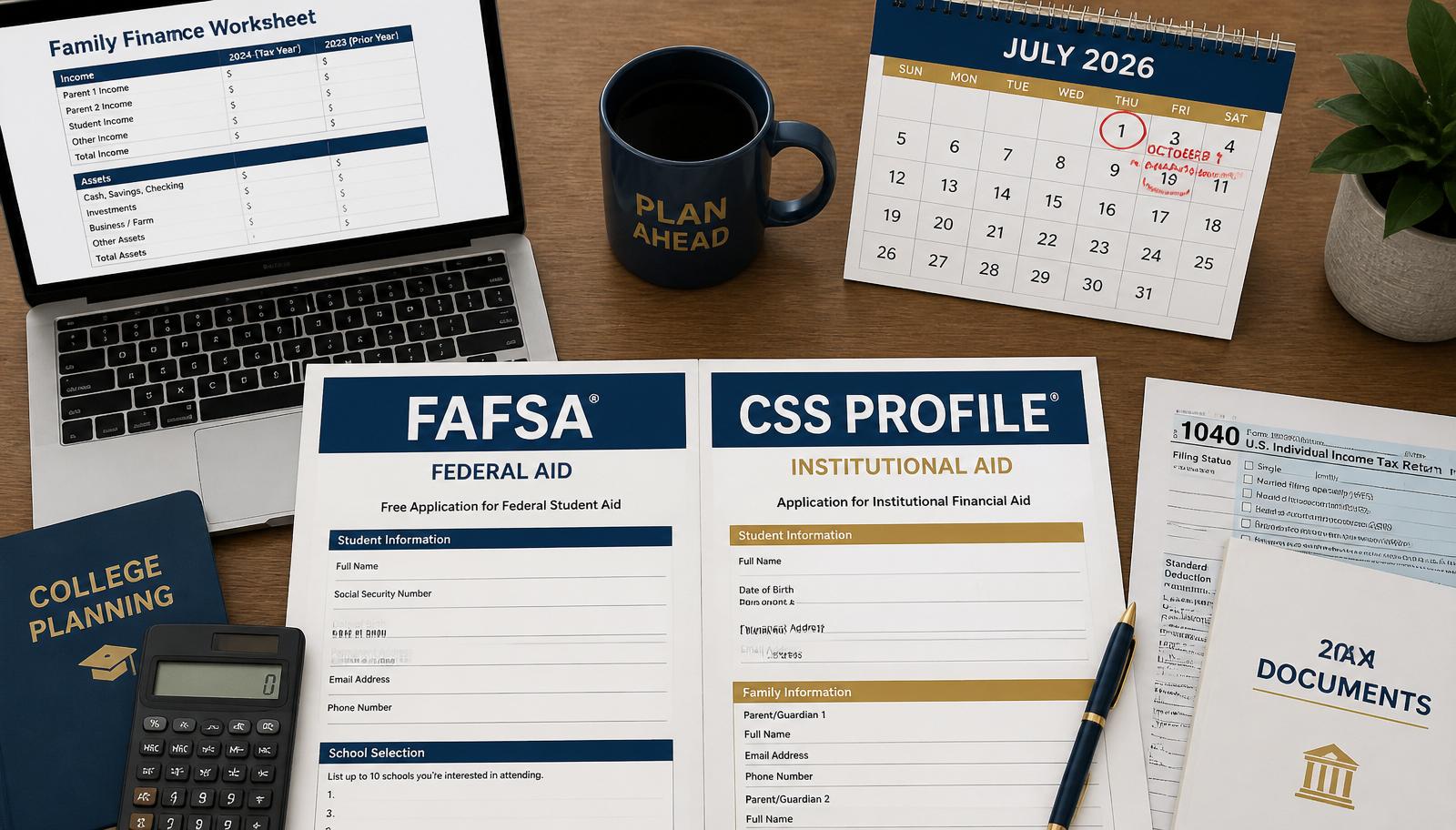
The one-sentence difference
The FAFSA is the free federal form that decides eligibility for federal aid: Pell Grants, federal student loans, and federal work-study. The CSS Profile is a separate, fee-based form run by the College Board that a smaller group of mostly private colleges uses to award their own institutional aid on top of anything federal.
In practical terms, the FAFSA is the government's form and the CSS Profile is the college's form. A family applying to a state university usually files only the FAFSA. A family applying to a selective private that meets full demonstrated need almost always files both.
Side-by-side: what each form actually does
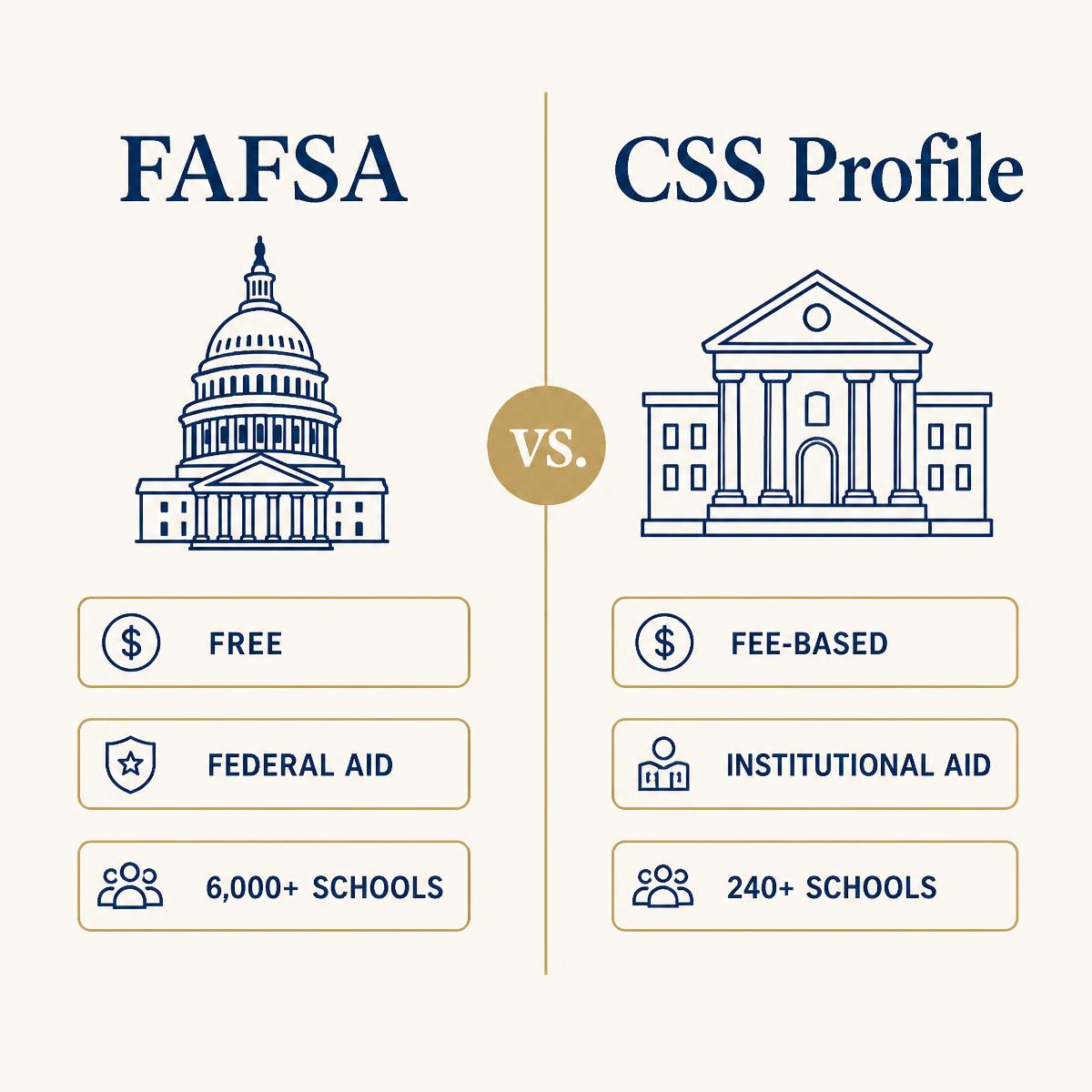
The chart below is the shortest honest summary of the two forms. Read it once, then use it to decide which forms every school on your list requires before you start any application.
- Who runs it: FAFSA is run by the U.S. Department of Education. CSS Profile is run by the College Board, the same nonprofit behind the SAT and AP.
- Cost to submit: FAFSA is free, always. CSS Profile costs 25 dollars for the first school and 16 dollars for each additional school; fee waivers are available for families that qualify.
- What it awards: FAFSA determines federal grants, federal loans, and work-study, plus most state aid. CSS Profile determines institutional grants and scholarships the school funds from its own endowment.
- How many schools use it: FAFSA is used by essentially every accredited college that participates in federal aid (thousands of schools). The CSS Profile is used by roughly 240 mostly private colleges, universities, and scholarship programs, per the College Board's participating institutions list.
- How deep it goes: FAFSA collects income and limited assets. CSS Profile collects income, assets, home equity, small-business ownership, medical expenses, and, at many schools, non-custodial parent finances.
When each form opens for 2026-27
For the 2026-27 aid year (the aid year that pays for freshman fall 2027), both forms open October 1, 2026. The FAFSA opening date is confirmed by Federal Student Aid; the CSS Profile also opens October 1 per the College Board.
State and institutional deadlines vary widely. Some priority deadlines land as early as November 1 for Early Decision schools; California's Cal Grant deadline is March 2; many private colleges set February deadlines for regular decision institutional aid. The right move is to pull every school's financial aid deadline from the school's own aid page and put them all in one calendar before October arrives.
Do I need to file the CSS Profile?
Only if a college on your list requires it. The full list of participating schools and programs lives on the College Board's CSS Profile school and program list. Check every school on your locked application list. If any require the CSS Profile, you file it. If none do, you skip it and file only the FAFSA.
A useful rule of thumb: if a private college advertises that it meets 100 percent of demonstrated need, or has an endowment large enough to fund substantial institutional grants, it almost certainly requires the CSS Profile. Public flagships and most state universities do not.
Documents you should pull together in July
Both forms ask for similar core documents. Pulling them into a single folder now means October filing takes an evening, not a weekend.
- Parent and student federal tax returns (form 1040) and W-2s from the prior-prior year. The 2026-27 aid year uses 2024 tax data.
- Records of untaxed income: child support received, veterans benefits, tax-deferred retirement contributions.
- Current bank statements for checking, savings, and brokerage accounts.
- Records of any 529 college savings plans owned by the parent or student.
- For the CSS Profile only: home equity estimates, small-business or farm ownership details, out-of-pocket medical and dental expenses, and, at many schools, the same documents from a non-custodial parent.
- Federal Student Aid IDs (FSA IDs) for both the student and one contributing parent. Create these now at studentaid.gov; processing can take up to three days.
The non-custodial parent question
This is where CSS Profile schools most often surprise divorced or separated families. The FAFSA asks only about the parent the student lived with more during the past 12 months, or the parent who provided more financial support if custody was equal. Many CSS Profile schools ask for the non-custodial parent's finances too, using a separate CSS Profile Non-Custodial Parent form.
Schools that require the non-custodial form use it to decide their own institutional aid; they do not send that data to the government. If a family has a genuine reason a non-custodial parent cannot participate (no contact for years, safety concerns, etc.), most CSS Profile schools accept a non-custodial parent waiver documented by a counselor or third-party professional. Ask the school's financial aid office directly.
How this affects the aid offer you actually get
At a CSS Profile school, the FAFSA sets your federal aid floor and the CSS Profile decides your institutional grant. That institutional grant is usually the largest single line item on a private-college aid offer, often larger than the Pell Grant and federal loans combined. Missing the CSS Profile at a school that requires it does not just cost a small scholarship; it can cost the entire need-based grant that made the school affordable in the first place.
When the offers arrive in the spring, compare them line by line rather than by top-line total. UniScorecard's side-by-side compare tool and the Financial Aid Award Letter guide walk through how to read what each school is actually offering after grants versus loans.
Common mistakes to avoid in October
Five patterns cost families real money every year. All five are avoidable with a July prep pass.
- Filing only the FAFSA at a school that also requires the CSS Profile. The federal aid arrives; the institutional grant does not.
- Waiting to create the FSA ID until October. Processing delays can push submission past a priority deadline.
- Guessing at asset values instead of pulling actual statements. Overstating assets reduces need-based aid; understating them can trigger a verification request.
- Skipping the non-custodial parent form at CSS Profile schools that require it. Some schools default to no institutional aid when it is missing.
- Treating the CSS Profile fee as a reason not to apply. Fee waivers cover the full fee for families that qualify, and the institutional aid unlocked is usually worth many multiples of the fee.
How to prep the rest of July and August
Between now and October 1, three actions matter more than any others. Create both FSA IDs this week so they are ready. Pull the 2024 tax return and current asset statements into a single folder. Confirm which schools on your list require the CSS Profile using the College Board's participating institutions list, and put every school's financial aid priority deadline into one shared calendar.
For the broader senior-year timeline that this financial aid work fits inside, use the FAFSA 2026-27 deadlines guide and the senior summer college application checklist.
FAFSA vs CSS Profile: which form do you actually need?
Start with the list of schools on your application list. Every U.S. college that participates in federal aid requires the FAFSA. Only about 240 mostly private colleges also require the CSS Profile for their own institutional grants.
If every school on your list is a public university or a private that does not use the CSS Profile, file only the FAFSA. If even one school requires the CSS Profile, file both forms by that school's earliest priority deadline.
- Check each school's financial aid page for the exact forms required.
- Use the College Board's participating institutions list to confirm CSS Profile schools.
- File the FAFSA for federal aid and the CSS Profile for institutional aid; one does not replace the other.
- Watch for non-custodial parent requirements at CSS Profile schools if parents are divorced or separated.
Further reading
On UniScorecard
- FAFSA 2026-27 deadlines guide
State-by-state and school-by-school deadlines that pair with the CSS Profile calendar.
- Financial aid award letter 2026
How to compare offers after both forms are in and awards land in the spring.
- How to pay for college
The full stack of grants, scholarships, loans, and work-study in one guide.
- Senior summer college application checklist
Weekly summer plan that slots financial aid prep alongside applications.
- Side-by-side compare
Stack federal net price and outcomes for finalist schools alongside your aid offers.
- School search
Look up any school to confirm net price and whether it participates in federal aid.
External sources
- Federal Student Aid: apply for FAFSA ↗
Official U.S. Department of Education FAFSA portal and instructions.
- CSS Profile ↗
Official College Board CSS Profile application and help center.
- CSS Profile participating institutions ↗
Full list of colleges and programs that require the CSS Profile.
- Create an FSA ID ↗
Set up the federal login both student and parent need before filing.
- College Scorecard ↗
Federal outcome and net price data to sanity-check aid offers.
Related guides
Merit Scholarships: How to Win More College Money
Merit scholarships cut college costs without a financial-need test. Learn who awards them, how much they are worth, and how to target them before applications open.
How to Get College Application Fee Waivers in 2026-27
See who qualifies for college application fee waivers in 2026-27, how to request them through Common App and NACAC, and what paperwork to gather before August 1.
How to Read a Financial Aid Award Letter (2026 Guide)
Decode your 2026-27 aid award letter in 15 minutes: gift aid vs loans, cost of attendance, comparing offers, and steps before the tuition deposit.
Frequently asked
- Is the CSS Profile required for every college?
- No. The CSS Profile is required only at roughly 240 mostly private colleges, universities, and scholarship programs. Check each school's financial aid page or the College Board's participating institutions list. If no school on your list requires it, you only need to file the FAFSA.
- Do I still need to file the FAFSA if I file the CSS Profile?
- Yes. At schools that require both forms, you must file the FAFSA to be eligible for federal aid such as Pell Grants and federal loans, and the CSS Profile to be considered for the school's own institutional grants.
- How much does the CSS Profile cost in 2026-27?
- 25 dollars for the first school and 16 dollars for each additional school. Fee waivers are automatic for U.S. domestic students whose family income is roughly under 100,000 dollars and for orphans or wards of the court under age 24, per current College Board policy.
- When do the FAFSA and CSS Profile open for the 2026-27 aid year?
- Both forms open on October 1, 2026, for the 2026-27 aid year that funds freshman fall 2027. Priority deadlines set by individual states and colleges vary and can be as early as November 1.
- Which form asks harder financial questions?
- The CSS Profile. It goes deeper than the FAFSA on assets, home equity, small-business ownership, medical expenses, and, at many schools, non-custodial parent finances. Plan more time for the CSS Profile even though the FAFSA is longer overall.
About the author
UniScorecard Editorial
Higher-education data team
We translate the U.S. Department of Education's College Scorecard into plain-language guides for students, families, and counselors. Every metric we publish is sourced directly from the federal Most Recent Cohorts institutional file.
Read our methodology →