Supplemental Essays: A Pre-August Plan for Class of 2027
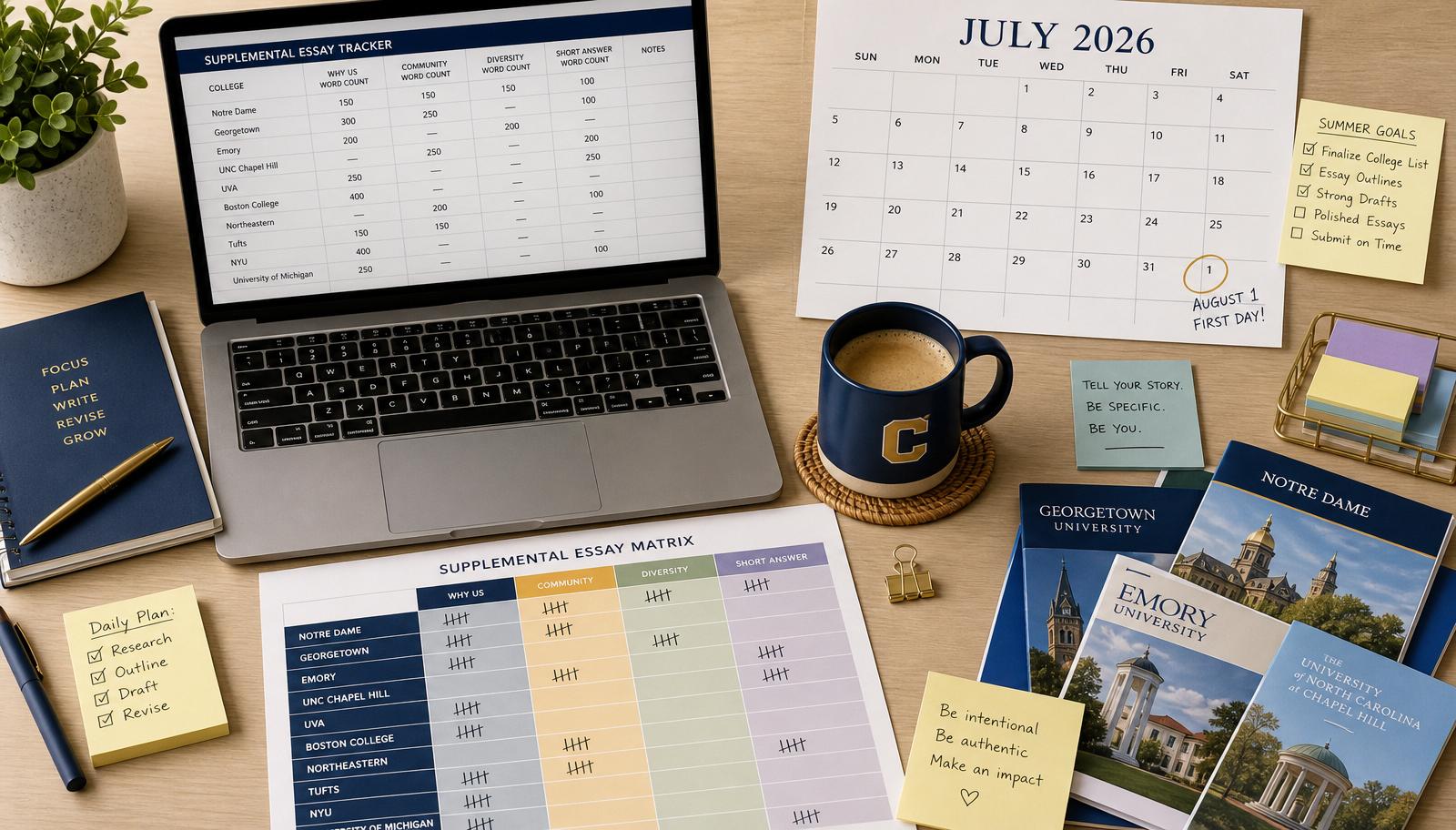
By the time Common App opens on August 1, 2026, most rising seniors will already be behind on supplements. Not because they cannot write, but because they never counted the essays. A student with ten schools on a locked list is often staring at twenty-five to forty additional prompts on top of the personal statement. This guide is the pre-August plan a Class of 2027 applicant reading this on July 7 can use this week to inventory every supplemental prompt, schedule the drafts, and open August 1 with a real work plan instead of a shock.
Higher-education data team
Sources: Sourced from the Common Application 2026-27 member requirements grid, the U.S. Department of Education's College Scorecard institutional file, and the National Association for College Admission Counseling (NACAC) State of College Admission report on application volume and essay workload..
Why supplements decide the fall, not the personal statement
The Common App personal statement is one essay of 650 words. Supplements are everything else, and they are where selective admissions decisions are actually shaped. A typical balanced list of ten schools produces somewhere between fifteen and forty supplemental prompts, ranging from 100-word short answers to 650-word community essays. The 2026-27 Common Application member requirements confirm that supplement counts vary widely by school, and the totals compound fast across a list.
Students who wait until August 1 to count the prompts spend September and October writing the same recycled paragraph across ten schools. Students who inventory in July write school-specific answers because they have the time to. The single best thing you can do this week is not draft any prompt at all. It is build the list of every prompt you will owe.
Step 1: Build the master prompt inventory
Open a spreadsheet and put every school from your locked list down the left column. Across the top, add columns for prompt text, word count, prompt type, required or optional, and draft status. For each school, pull the current supplemental prompts from three sources so you do not miss one.
- The school's admissions website under Apply or First-Year Requirements. This is the authoritative source for prompt wording.
- The Common App applicant guide for the 2026-27 member list and which schools carry writing supplements at all.
- The school's Common Data Set section C, which lists whether the school considers essays as an admission factor. Schools that mark essays as very important almost always attach supplements worth extra attention.
- For public universities that do not use Common App, check the school's own portal. Many state systems open essay prompts in July, ahead of the August 1 Common App date.
Step 2: Bucket every prompt into one of five families
Supplemental prompts read like a hundred different questions, but they collapse into a small number of patterns. Tagging each prompt by pattern in your tracker is what unlocks the reuse work later. A Why Us essay for one school shares research and structure with a Why Us essay for another school, even when the wording is different.
- Why Us: why this specific college, program, or major. Requires school-specific research. Covered in depth in the Why This College essay guide.
- Community: a community you belong to and what you contribute to it. Often the longest supplement on the list at 250 to 650 words.
- Diversity or Identity: a background, perspective, or experience that shapes how you would contribute to the campus. Common at selective privates.
- Intellectual or Academic: a book, idea, question, or problem that interests you. Common at liberal arts colleges and honors programs.
- Short Answer: 100 to 250 word answers to prompts like favorite activity, roommate letter, or quick creative questions. These add up fast; ten short answers is a full weekend of work.
Step 3: Read the tracker to spot reuse (without recycling)
Once every prompt is tagged, the tracker shows you which essays share DNA. A 250-word Community essay for one school will not paste into another school unchanged, but the underlying story, the specific moment, and the reflection can carry across two or three prompts with rewritten framing. This is legitimate reuse, and it is different from generic recycling that admissions readers catch immediately.
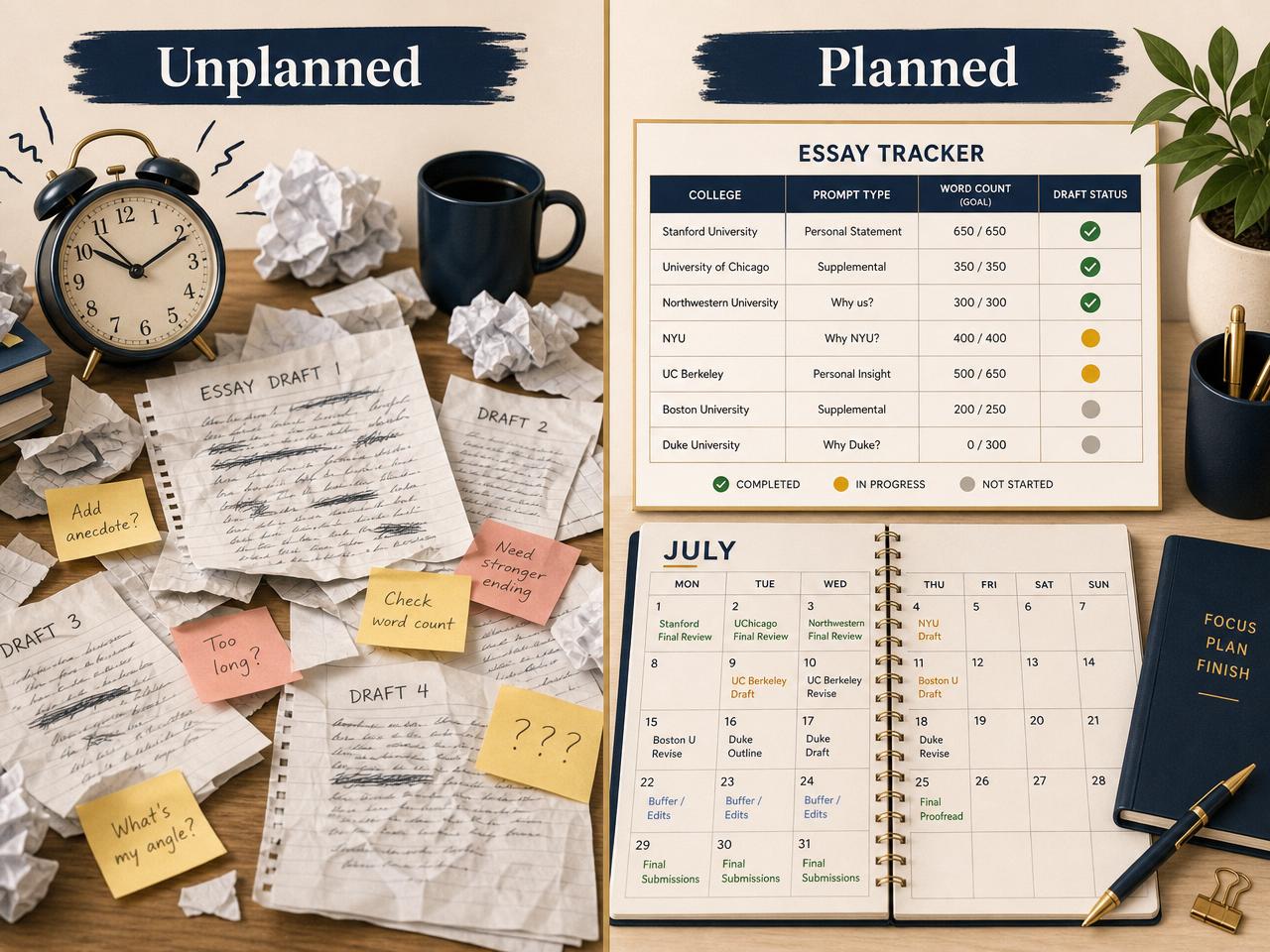
The side-by-side below shows what the reuse looks like when the tracker is honest about it. On the left is the unplanned approach that produces the same paragraph five times. On the right is the planned approach that anchors each prompt in a real answer to that school's specific question while drawing on a shared library of two or three well-developed personal stories.
- Unplanned: one long draft copied and lightly edited across five community prompts, all reading as generic. Admission readers flag the pattern within one paragraph.
- Planned: a core story bank of two to three personal moments, each rewritten to answer that specific school's specific prompt with different framing and specific school details.
- Same effort in hours. Very different signal in an admissions folder.
Step 4: Schedule the drafts across July and August
A prompt inventory without a calendar is a wish list. The schedule below fits inside a normal summer and leaves September for supplement polish and October for the Free Application for Federal Student Aid (FAFSA) opening. The core rule is one prompt family per week, so you are not switching cognitive modes every day.
- Week of July 7: finish the master prompt inventory and prompt bucketing for every school on your locked list.
- Week of July 14: research and outline every Why Us prompt. No drafting yet. Focus on visiting each school's academic department pages and pulling three specific hooks per school.
- Week of July 21: draft Community and Diversity essays. These are the longest per school; give them the full week.
- Week of July 28: draft Intellectual and Short Answer essays. Short answers are quick individually, but the batch is large.
- August 1: Common App opens. Load every school on day one, paste in the drafts, and see how each answer reads inside the actual application preview.
- August 4 to 15: full revision pass on every supplement, school by school. Read out loud. Cut every sentence that could apply to any other school on the list.
- August 16 to 31: a counselor or trusted reader passes every essay. You revise once more from their notes. Nothing new after Labor Day except final polish.
Step 5: Use federal outcomes data inside the Why Us essays
The strongest Why Us essays cite specific programs, faculty, courses, and outcomes. The weakest cite prestige and weather. When you research each school in the week of July 14, pull the four federal outcome numbers UniScorecard publishes for every institution and weave the ones that matter to you into the essay. The numbers are public on the College Scorecard file and the National Center for Education Statistics College Navigator tool.
For each school, note the six-year graduation rate, the median earnings ten years after entry, the average net price for your family's income bracket, and the field of study share for your intended major. A Why Us paragraph that names the specific outcome you are drawn to reads very differently from one that names the campus quad. Cross-reference with UniScorecard's side-by-side compare tool to see how two or three finalist schools stack on the same four numbers.
Common supplement mistakes to fix in July
Five patterns kill supplements. Fix them now while there is still time to rebuild the plan, not in October when there is not.
- Recycling a Why Us essay by swapping the school name. Admission readers see this every fall and it reads as low effort every time.
- Repeating the personal statement inside a Community essay. The supplement exists to add new information, not restate the main essay.
- Answering the prompt you wish had been asked instead of the one on the page. A brilliant essay that misses the question loses on relevance.
- Writing to the word ceiling on a 100-word short answer. Short answers reward precision, not padding.
- Waiting for inspiration. Inspiration is a schedule problem in disguise. Fix the schedule and the writing follows.
How this plan fits the rest of the fall application load
Supplements are one of six moving pieces this fall. The others are the Common App personal statement, letters of recommendation, the activities list, the FAFSA, and any Early Decision or Early Action deadline choices. A pre-August supplement plan protects the rest of the load by clearing the largest unknown before the calendar tightens.
Pair this plan with the senior summer college application checklist for the full weekly summer view, the Common App essay prompts 2026-27 guide for the personal statement work happening in parallel, and the Early Decision vs Early Action 2027 guide so the supplement calendar reflects your ED and EA deadlines.
Further reading
On UniScorecard
- Why This College essay guide
The full playbook for the Why Us prompt family that dominates supplement work.
- Common App essay prompts 2026-27
The main personal statement runs in parallel with supplements this summer.
- Senior summer college application checklist
Weekly summer plan the supplement schedule slots into.
- How to build a balanced college list
Lock the list before you inventory prompts; an open list means wasted essays.
- Early Decision vs Early Action 2027
Deadline choices change which supplements you owe first in November.
- Common App activities list guide
The activities list feeds the material you will draw on inside supplements.
- School search
Confirm the schools on your inventory and pull federal outcome data for each Why Us essay.
- Side-by-side compare
Stack federal outcomes for finalist schools while researching Why Us paragraphs.
External sources
- Common App writing supplements guide ↗
Official 2026-27 guidance on which member schools require supplements.
- College Scorecard ↗
Federal outcome data to cite specifically inside Why Us paragraphs.
- College Navigator ↗
NCES institutional profiles for program and enrollment details.
- NACAC research reports ↗
State of College Admission data on essay weight and application volume.
- Common Data Set initiative ↗
Locate a school's Common Data Set to confirm essay weight in admission decisions.
Related guides
Why This College Essay: How to Write One That Wins
A step-by-step guide to the Why This College supplemental: research, structure, worked examples, and mistakes to avoid before the August 1 open.
Common App Activities List: 10 Examples for 2026-27
10 Common App activities list examples showing how to order, quantify, and describe entries for the 2026-27 cycle, plus what readers look for.
How to Get College Application Fee Waivers in 2026-27
See who qualifies for college application fee waivers in 2026-27, how to request them through Common App and NACAC, and what paperwork to gather before August 1.
Frequently asked
- How many supplemental essays should I expect for ten colleges?
- A typical list of ten selective colleges produces between fifteen and forty supplemental prompts, depending on which schools are on the list. Selective privates often require three to five supplements each; large public universities often require one or none. Build the inventory before you count on an average.
- When do 2026-27 supplemental essay prompts get released?
- Most schools publish supplemental prompts in June and July, ahead of the August 1 Common App open date. A small number of schools update prompts as late as mid-August. Refresh your prompt inventory the last week of July to catch late changes.
- Can I reuse a supplemental essay across multiple colleges?
- You can reuse a personal story or thematic material across two or three schools with rewritten framing and school-specific details. You cannot reuse a school-specific Why Us paragraph by swapping the school name. Admission readers spot the swap immediately.
- Are optional supplemental essays actually optional?
- At selective colleges, optional supplements are effectively expected from competitive applicants. If a school offers an optional essay and you skip it; you are giving up a place to add specific evidence about fit. Treat optional as recommended unless a counselor advises otherwise for your specific situation.
- How long should I spend on each supplemental essay?
- Budget roughly two to four hours per 250-word supplement including research, outline, draft, and one revision. Short answers under 150 words take about an hour each once you have the story in mind. Why Us essays take the longest because the research is per-school.
About the author
UniScorecard Editorial
Higher-education data team
We translate the U.S. Department of Education's College Scorecard into plain-language guides for students, families, and counselors. Every metric we publish is sourced directly from the federal Most Recent Cohorts institutional file.
Read our methodology →