How to Ask Teachers for Letters of Recommendation (2026)
The last day of junior year is the single most important deadline in the recommendation-letter timeline, and almost no one circles it on a calendar. Once a teacher walks out of the building for summer break, the next time they will sit down to think carefully about your year is late August, in a hallway, between bell schedules, with twenty other students lining up to ask the same question. Asking before that door closes is the difference between a letter written from memory in twenty minutes and a letter written from notes over a quiet weekend in September. This guide is the timeline, the email script, and the brag sheet a rising senior reading this in late June 2026 can use this week.
Higher-education data team
Sources: Sourced from the Common Application's published recommender requirements, the National Association for College Admission Counseling (NACAC) State of College Admission report, the College Board's Big Future apply hub, and the published first-year application requirements of more than twenty four-year U.S. colleges including MIT, Johns Hopkins, the University of Virginia, the University of Michigan, and the University of California system..

Why late June is the real deadline, not September
Almost every selective four-year college that accepts the Common Application requires two teacher recommendations and one counselor recommendation. The Common App opens August 1 for the 2026-27 cycle, Early Decision and Early Action deadlines are clustered around November 1 and November 15, and counselors will tell you the same thing every fall: the recommenders who write the strongest letters are the ones who said yes in June.
The reason is not laziness. A high school English or history teacher is responsible for somewhere between 90 and 150 students in a typical year. By October, that teacher is probably writing 15 to 25 recommendation letters on top of grading, lesson planning, and a full teaching load. The students who asked in June get the first writing slots, the freshest memory of classroom moments, and a recommender who is not trying to remember which Sophia is in front of them.
Who actually counts as a strong recommender
The Common App requires that teacher recommendations come from a teacher who taught you an academic subject. For most colleges that means English, math, science, social studies, or a world language. Art, music, and elective teachers can be a powerful additional letter when a college accepts a third recommendation, but they generally do not replace the two academic letters the application asks for.
Beyond the subject rule, the strongest recommenders share three traits. They taught you recently (junior year is ideal), they saw you stretch (not just earn an A, but work through something hard), and they can write specifically about who you are in a classroom. A teacher who gave you a B but watched you grow across the year is almost always a stronger recommender than a teacher who gave you an A in a class that came easily.
- Recent: a junior-year teacher beats a freshman-year teacher every time, even if the freshman teacher loved you.
- Academic: pick from your core academic subjects unless a specific program (engineering, music, art) asks for something different.
- Specific: the teacher should be able to name a moment, a paper, or a contribution that was distinctly yours.
- Balanced: aim for one humanities and one STEM letter so admissions readers see you across subject areas.
- Willing: a teacher who hesitates is doing you a favor. A lukewarm letter is worse than a missing one.
The four-step timeline that actually works
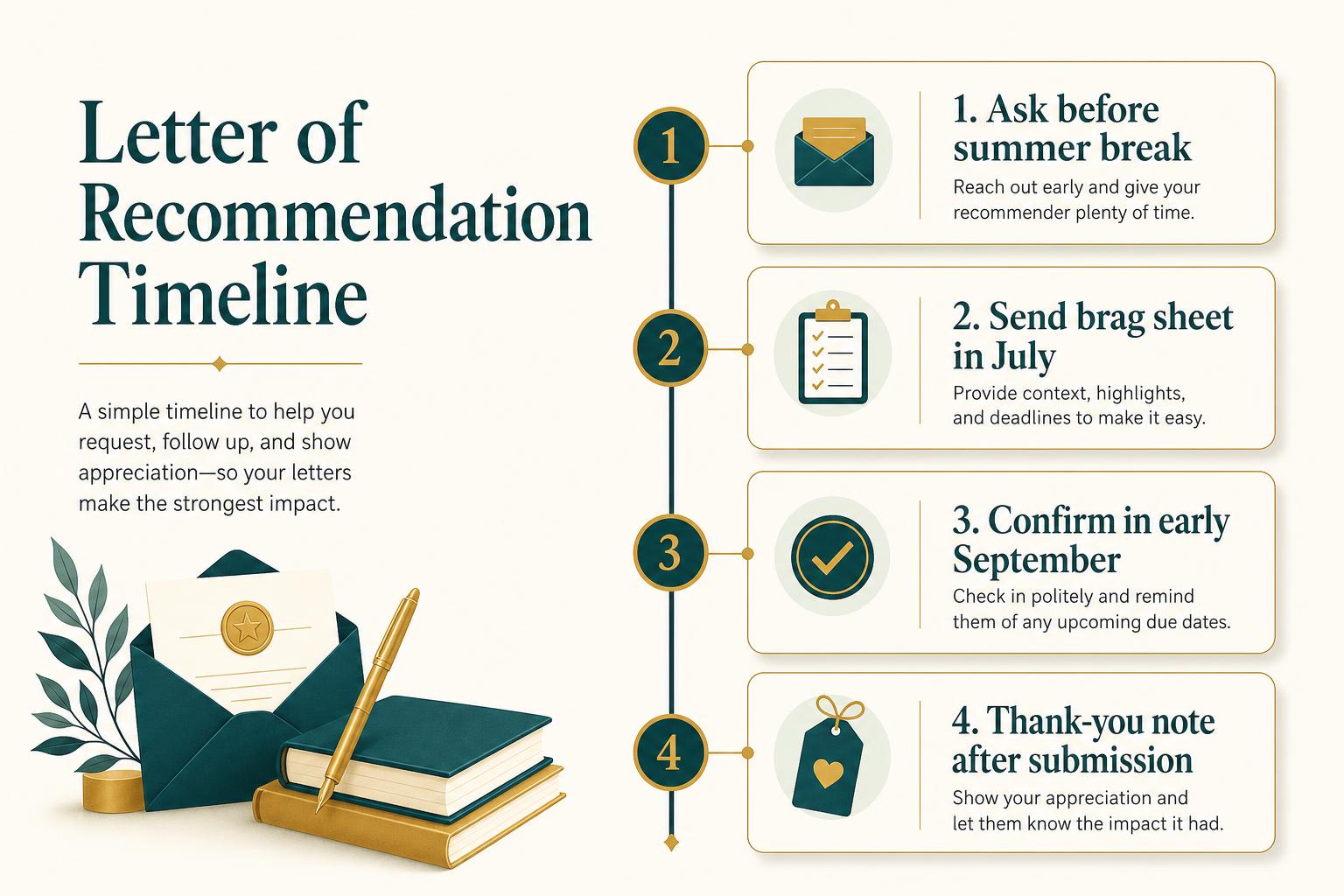
Build the recommendation timeline backwards from the earliest deadline on your school list. For a student applying Early Decision November 1, the letter needs to be uploaded to the Common App portal by mid to late October, which means the teacher needs the request in hand before summer break and the brag sheet in hand by mid-July.
- Step 1, before the last day of school (target: this week): ask in person, then follow up with a short email so the teacher has the request in writing.
- Step 2, by mid-July: send the brag sheet, your resume, a draft school list with deadlines, and the FERPA waiver confirmation from the Common App.
- Step 3, first week of September: send a short check-in email confirming the school list is final and listing the first deadline.
- Step 4, within a week of each letter being submitted: send a handwritten thank-you note. Update the teacher in the spring when admissions decisions come back.
The exact email to send (copy, edit, send today)
Ask in person first. A face-to-face request gives the teacher room to say no without awkwardness, and it gives you a real answer instead of an email that gets buried. Follow up within 24 hours with an email so the request is in writing and the teacher has the dates and details at hand.
Use a version of this template. Keep it short. Teachers appreciate a request they can answer in two minutes.
- Subject line: Recommendation letter request, [Your full name], Class of 2027
- Opening: thank the teacher for the year and name one specific thing the class gave you (a unit, a project, a discussion).
- The ask: ask directly whether they feel comfortable writing a strong letter of recommendation for your college applications.
- The logistics: note that you will send a brag sheet and resume by mid-July, that the earliest deadline is around November 1, and that all letters go through the Common App portal.
- Close: thank them again, give a date by which you would like a yes or no (one week is reasonable), and offer to answer any questions in person before the last day of school.
What goes in a brag sheet that teachers actually use
A brag sheet is one to two pages of context a teacher uses to ground the letter in specifics. It is not a resume dump. Think of it as the answer to the question the teacher will silently ask while writing: what do I want this admissions reader to remember about this student a week from now?
Keep the document short. Two pages is the ceiling. Every section should help the teacher write a sentence they could not write on their own.
- Basic info: full legal name, pronouns, graduation year, your counselor's name, and the email the teacher will use to upload to the Common App.
- Three classroom moments: name a paper, a project, a discussion, or a question you asked that the teacher might remember. Date each one. This is the section that becomes the letter's opening anecdote.
- What you want colleges to know about you: three to five sentences, written in your own voice, that name the qualities you hope the letter highlights.
- Activities and roles: the four or five activities that have shaped you most, with a one-line description of what you actually do.
- Goals: one paragraph on what you plan to study and why. Even a tentative answer is useful. Colleges read recommendations for fit alongside the personal statement.
- School list and deadlines: a simple table with the colleges, application platforms, and the earliest deadline at each.
- A clear no-pressure note: thank the teacher for the time and confirm you are happy to provide anything else they need.
The counselor letter is a different animal
The counselor recommendation is required by nearly every Common App member college and is treated differently from a teacher letter. The counselor is writing the school's official letter, with school context, course rigor commentary, and any disciplinary or attendance notes the college is entitled to see. The NACAC State of College Admission report consistently lists the counselor recommendation among the factors admissions offices consider, alongside the strength of curriculum and grades in college-prep courses.
What that means in practice for the summer task list is that the counselor needs a brag sheet too, often the school's own template. Many high schools require a senior questionnaire and a parent questionnaire to be completed before the counselor will write. If your school uses Naviance, SCOIR, or MaiaLearning, log in this week, complete what is open, and email your counselor to confirm what else they need before the school year starts.
Subject-specific letters for engineering, music, and the arts
Some programs ask for a letter that the Common App's two-teacher default does not cover. Engineering programs often request a math or science teacher specifically. The MIT first-year application requirements ask for one math or science teacher and one humanities, social science, or language teacher. The Johns Hopkins application page lists two teachers and a counselor, with subject flexibility. Music, art, and theater programs typically request an additional arts recommendation, sometimes with a portfolio or audition.
If a school on your list has a subject-specific recommender requirement, lock that letter in first. The pool of math and science teachers willing to write is smaller than the pool of English teachers, and the strong ones get booked early. The University of Virginia first-year admissions page and the published first-year requirements at most flagship publics are the cleanest places to confirm the exact rule for each school on your list.
What to do if a teacher says no, or says nothing
A teacher who says no is doing you a favor. A lukewarm or generic letter from a teacher who agreed reluctantly can quietly damage an application that is otherwise strong. Thank the teacher for the honesty, then move to your second choice without making it awkward.
A teacher who says nothing is harder. If you have not heard back within a week of asking, send a brief polite follow-up. If you still have not heard back by the last day of school, treat it as a no and ask a different teacher before summer starts. Counselors will confirm the same thing: a recommender who is hard to reach in June will be harder to reach in October.
The September follow-up that protects your timeline
By the first week of September, the school list has usually shifted from the version you shared in June. New schools have been added, a couple have been cut, and an early-application decision has firmed up. Send each recommender a short update with the final school list, the earliest deadline, and a one-sentence thank-you. This is the email that prevents the worst recommendation-letter outcome: a teacher who writes the letter in late October only to discover the early deadline was two weeks ago.
Pair the September update with a quick review of the rest of the file. Our senior summer checklist and the Common App essay prompts guide walk through the parallel work that should already be in motion. Families weighing an early application should read Early Decision vs Early Action 2027 before locking in a November 1 deadline that pulls the recommendation timeline forward by a month.
How recommendations fit the rest of the application
Recommendations are one signal in a file that includes the transcript, the personal statement, the activities list, supplements, and (for some schools) test scores. The latest NACAC State of College Admission report places recommendations in the second tier of importance at most four-year colleges, behind grades in college-prep courses and the strength of curriculum, but ahead of demonstrated interest at most institutions.
What a great recommendation does is corroborate. The transcript shows the grade. The recommendation explains how the student earned it.
The personal statement shows the voice. The recommendation confirms that voice is real in a classroom. The students who think about recommendations as part of the whole file (not a box to check) tend to end up with letters that move the needle.
Build the school list the letters are sent to
A strong recommendation is wasted if it is sent to the wrong list. Before summer ends, use a federally sourced data set, not a brochure, to pressure-test every school on your list. UniScorecard's school search and side-by-side compare pull verified graduation rate, net price, and median earnings from the College Scorecard so a family can see whether the schools the letters are going to actually match the outcomes the family wants.
Run a simple gut check before mid-August. Open the school list. For each college, write one sentence on why it belongs.
If the sentence is a brochure cliche, dig further or drop the school. The recommenders are doing real work on your behalf. The list they are writing to deserves the same care.
What to do this week
It is the fourth week of June. If you are a rising senior reading this with the last day of school still ahead, three actions this week put you ahead of almost every classmate.
- Pick two junior-year academic teachers, one humanities and one STEM if possible, and ask each one in person within the next five days.
- Draft the brag sheet outline tonight. The first pass takes 45 minutes. Polish it in early July before sending.
- Email your counselor this week to confirm the school's process, any required questionnaires, and the platform (Naviance, SCOIR, MaiaLearning) the school uses to coordinate letters.
Further reading
On UniScorecard
- Senior summer college application checklist
Week-by-week summer task list that the recommendation request sits inside.
- Common App essay prompts 2026-27
The personal statement that recommendations corroborate.
- Early Decision vs Early Action 2027
How an early-round choice pulls the recommendation deadline forward.
- Demonstrated interest colleges 2026
Which schools weigh interest signals alongside teacher letters.
- How to compare colleges
Pressure-test the school list before letters get sent.
- School search
Verified outcomes for every Title IV institution on your list.
- Side-by-side compare
Put two to four schools next to each other on outcomes and price.
External sources
- Common App first-year application ↗
Official recommender requirements, FERPA waiver, and submission rules.
- NACAC ↗
Publisher of the State of College Admission report referenced throughout this guide.
- College Board Big Future apply hub ↗
Plain-language college application guidance from the College Board.
- MIT first-year admissions ↗
Subject-specific recommender requirements for an engineering-heavy school.
- Johns Hopkins apply ↗
First-year application requirements including teacher and counselor letters.
- University of Virginia apply ↗
First-year recommendation guidance from a flagship public.
- Federal Student Aid ↗
Parallel financial aid timeline that runs alongside the recommendation request.
- College Scorecard ↗
Federal outcomes data the recommendation list should be pressure-tested against.
Related guides
Supplemental Essays: A Pre-August Plan for Class of 2027
How Class of 2027 applicants can inventory, schedule, and outline every college supplemental essay before Common App opens on August 1, 2026.
How to Build a Balanced College List (Class of 2027)
A data-driven method for building a balanced college list of 8 to 12 schools before August 1: reach, target, and likely tiers with real federal numbers.
Why This College Essay: How to Write One That Wins
A step-by-step guide to the Why This College supplemental: research, structure, worked examples, and mistakes to avoid before the August 1 open.
Frequently asked
- When should I ask teachers for college recommendation letters?
- Ask before the last day of junior year. For the 2026-27 application cycle that means asking by the end of June 2026 for most U.S. high schools. Teachers write the strongest letters when they have a quiet stretch to write, fresh memory of your year, and a brag sheet in hand. Students who wait until September are competing for the smallest writing slots with the largest letter loads.
- How many letters of recommendation do colleges require?
- Most colleges that accept the Common Application require two teacher recommendations from academic subjects and one counselor recommendation. Some programs (engineering, music, art) ask for an additional subject-specific or portfolio letter. A handful of colleges accept an optional third recommendation from a coach, employer, or mentor. Check each school's first-year application requirements before asking a third recommender.
- What should be in a brag sheet for teachers?
- Keep the brag sheet to one or two pages. Include your full name and graduation year, three specific classroom moments the teacher might remember, three to five sentences on what you hope the letter highlights, your top four or five activities with a one-line description each, a short paragraph on what you plan to study and why, and a simple table listing the colleges, platforms, and earliest deadline at each school on your list.
- Can I ask a teacher who gave me a B for a recommendation?
- Yes, and sometimes that is the stronger choice. Admissions readers value letters that describe how a student worked through challenge, asked good questions, and grew across a year. A teacher who watched you turn a B into real understanding can write a more specific letter than a teacher who gave you an easy A. The grade matters less than the teacher's ability to describe you in a classroom.
- What if a teacher does not respond to my recommendation request?
- Send a brief, polite follow-up email after one week. If you still have not heard back by the last day of school, treat the silence as a soft no and ask a different teacher before summer break. A recommender who is hard to reach in June will be harder to reach in October when the first deadlines hit. Replacing the request early is far better than chasing a missing letter in the week before a November deadline.
About the author
UniScorecard Editorial
Higher-education data team
We translate the U.S. Department of Education's College Scorecard into plain-language guides for students, families, and counselors. Every metric we publish is sourced directly from the federal Most Recent Cohorts institutional file.
Read our methodology →